10xTravel is part of an affiliate sales network and receives compensation for sending traffic to partner sites, such as CreditCards.com. This site may earn compensation when a customer clicks on a link, when an application is approved, or when an account is opened. This compensation may impact how and where links appear on this site. This site does not include all financial companies or all available financial offers. Terms apply to American Express benefits and offers. Enrollment may be required for select American Express benefits and offers. Visit americanexpress.com to learn more. All values of Membership Rewards are assigned based on the assumption, experience and opinions of the 10xTravel team and represent an estimate and not an actual value of points. Estimated value is not a fixed value and may not be the typical value enjoyed by card members.
Note: Some of the offers mentioned below may have changed or may no longer be available. The content on this page is accurate as of the posting date; however, some of our partner offers may have expired. You can view current offers here.
Add up what you spent last year on car insurance, the dentist, daycare, the vet, and the guy who fixed your water heater. For most households that number is not small.
Now look at what you earned on it. One point per dollar. Every one of those categories sits outside the bonus structure of the cards in your wallet. Groceries, restaurants, and travel get all the attention because those are the strongest bonus categories across the industry. Meanwhile, the boring, unavoidable, four-figure expenses get nothing, just the standard 1x.
But now there is a way to earn three points per dollar on all of it, with no categories to track, and the mechanism that unlocks it costs you nothing on net. It is the Bilt Palladium Card running its Points Accelerator.
The catch is not the cost. The catch is that most people spend their Bilt Cash on the wrong thing first, and it quietly costs them points every single year. This article walks through what the accelerator is, why it is free, and the order you should be using it in.

What the Points Accelerator Actually Is
The Bilt Palladium earns 2X points on everyday purchases, uncapped, excluding rent and mortgage. That is the baseline.
The Points Accelerator adds a full extra point per dollar on top of that. One activation costs $200 in Bilt Cash and grants +1X bonus points on all everyday spend for the next $5,000. You get up to five activations a year, and it is available to Bilt Obsidian Card and Palladium cardholders only. The no annual fee Bilt Blue Card (see rates & fees) cannot use it at all.
So if you’re doing the math, that is 3X on every purchase inside that $5,000 window. Three points per dollar on your insurance premium, your kid’s tuition payment, the plumber, the vet, and the emergency root canal.
Five activations at $5,000 each covers $25,000 of spending at 3X every year. Everything beyond that earns the base 2X, which is still a strong uncapped rate.
Why it Costs You Nothing
Here is the part that sounds too good to be true.
An activation costs $200 in Bilt Cash. The Palladium hands you $200 in Bilt Cash every year as a card benefit (up to $100 of Bilt Cash earned rolls over to the next year), so your first activation of the year is already paid for before you swipe once.
Then the loop closes on itself. Bilt Cash is earned at 4% of your everyday spend when you elect Flexible Bilt Cash. The activation you just bought covers $5,000 of spending. And 4% of $5,000 is exactly $200.
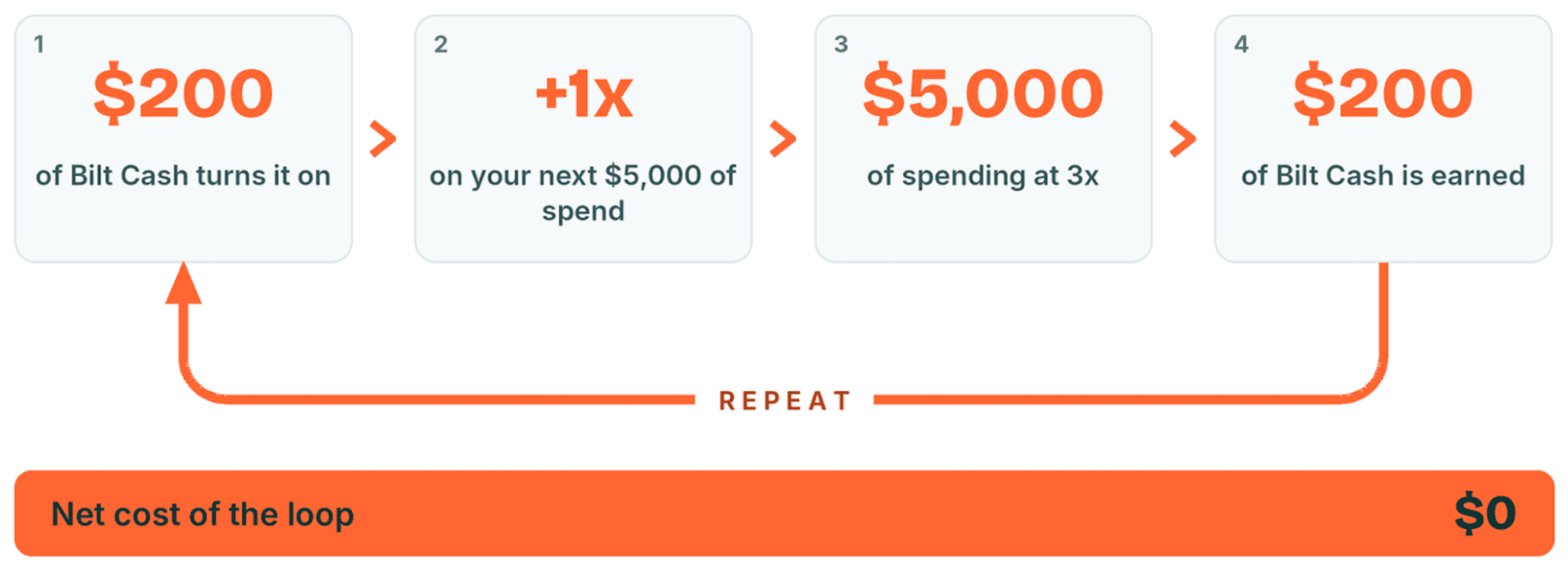
The spending that the accelerator covers generates precisely the amount of Bilt Cash needed to run it again. Net cost of the loop: $0. That is not a rounding artifact or a rosy assumption. It is $5,000 × 0.04 = $200, and $200 is one activation.
Yes, Bilt is the Rent Card. That is Not the Argument.
Bilt built its entire brand on earning points for paying rent and mortgage, and that mechanism is real. But under Bilt Card 2.0, you do not earn points on housing directly. You earn Bilt Cash on your spend, then redeem that Bilt Cash to unlock the points from your housing payment.
The rate: every $30 in Bilt Cash redeemed earns 1,000 points, up to 1X of your monthly rent or mortgage payment.
So the real question is not whether to use Bilt. It is what you spend your Bilt Cash on, because you only have so much of it and there are two things worth buying with it.
Option one, housing points. $30 of Bilt Cash buys 1,000 points. That is 33.3 points per dollar of Bilt Cash.
Option two, an accelerator activation. $200 of Bilt Cash buys 5,000 points. That is 25.0 points per dollar of Bilt Cash.
Housing points are the better rate, but if efficiency were the only thing that mattered, you would put every dollar of Bilt Cash toward housing and never touch the accelerator.
Why the Better Rate Loses
Read that conversion rule again, specifically the last seven words: up to 1X of your monthly rent or mortgage payment.
Your housing bill is a ceiling. You cannot earn more points on housing than what your monthly housing payment actually is, and you will have excess Bilt Cash that you can no longer use toward it.
Here is what that ceiling looks like in dollars.
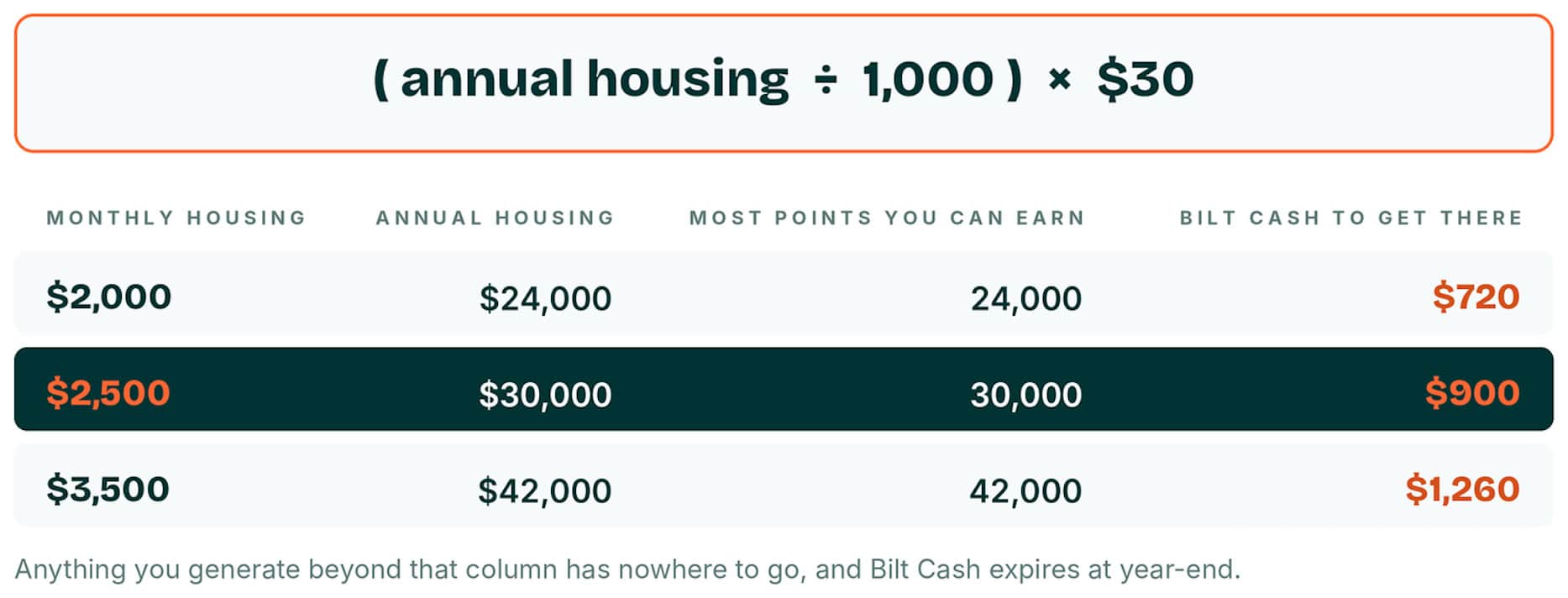
At $2,500 a month in rent, that is $30,000 a year in housing, which caps out at 30,000 points. To unlock those 30,000 housing points you would need to spend $900 of Bilt Cash across the year.
Now compare that to what you generate. Bilt Cash comes back at 4% of everyday spend, so $22,500 of spending produces exactly $900. That is the number that fills your housing ceiling.
Every dollar past $22,500 makes Bilt Cash your housing cannot use. And because the Palladium hands you $200 in Bilt Cash a year on top of that, you actually hit the ceiling at $17,500 of spend.
Say you put $30,000 on the card. That is $1,200 in Bilt Cash from spend plus the $200 credit, so $1,400 total against a $900 ceiling. The other $500 has nowhere to go, and Bilt Cash earned during the calendar year expires at year-end, with only up to $100 rolling into the next year.
The Math, Three Ways
Same card, same $2,500 a month in housing. Only the annual spend changes.
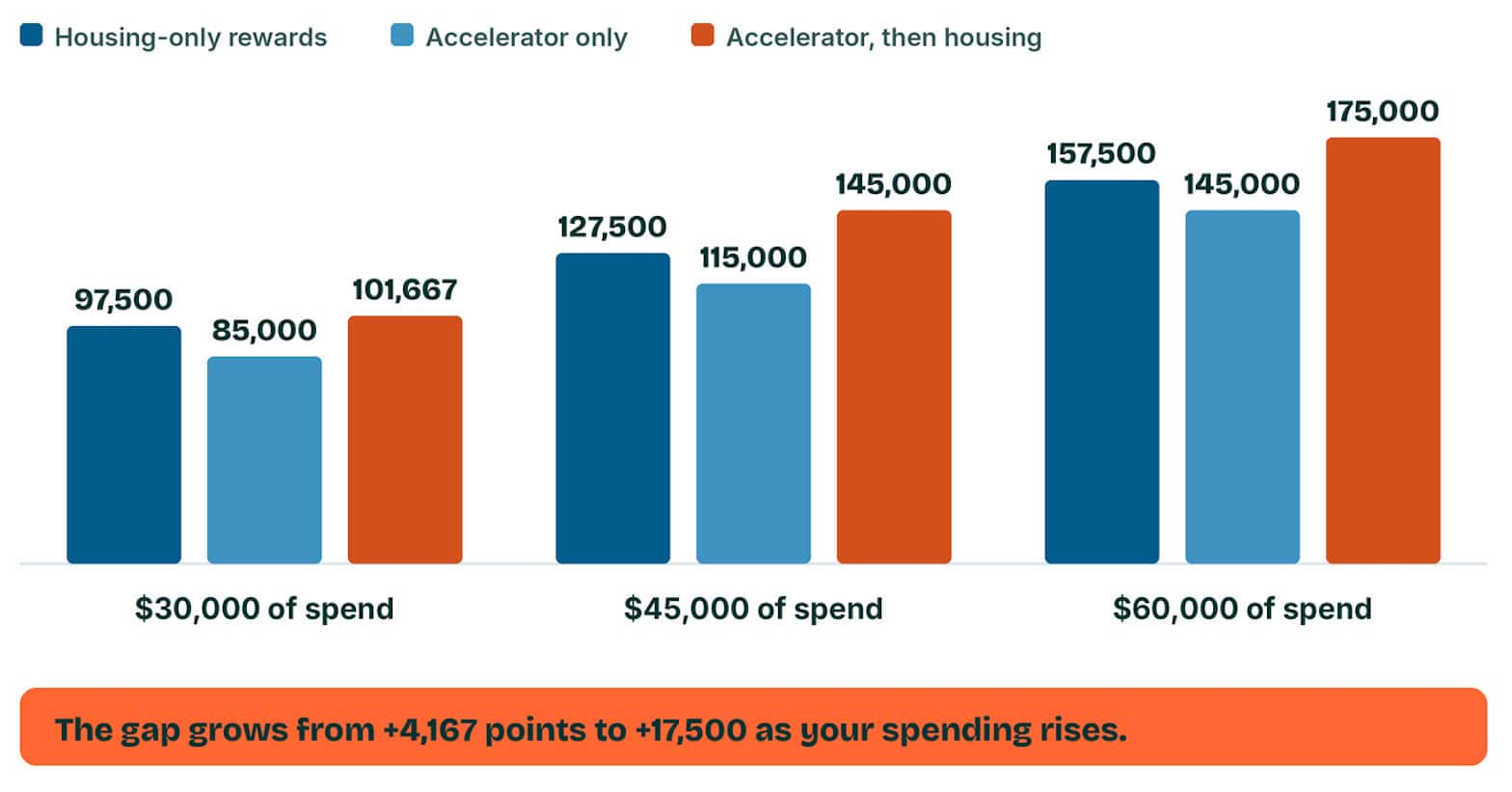
The conclusion is worth noticing.
Accelerator first wins at every level, by 4,167 points at $30,000 of spend and by 17,500 at both $45,000 and $60,000. The gap widens as your spending rises relative to your housing bill, because more spend means more Bilt Cash, and your housing ceiling does not move.
How Many Activations Are Right for You
Five is the maximum. Five is not always the answer.
Here is every option at $30,000 of spend against a $30,000 housing bill, which generates $1,400 in Bilt Cash against a $900 housing ceiling.
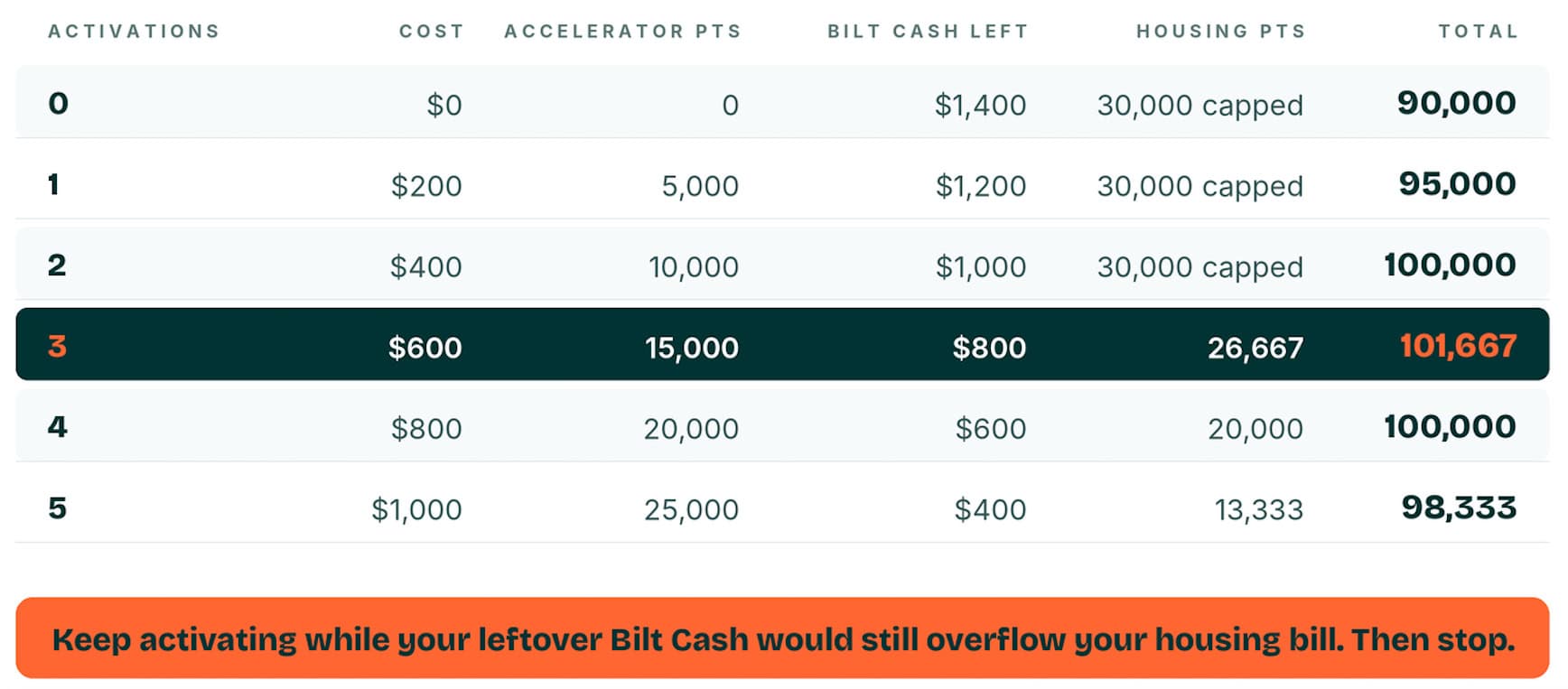
Look at rows zero through two. The housing column says “capped” in every one of them. Your housing bill has already soaked up everything it can, and you are sitting on Bilt Cash with nowhere to put it. Every activation in that range is funded by money that would have expired.
Row three is the sweet spot. You have $800 left, which converts to 26,667 points, just under your 30,000-point ceiling. Nothing capped, nothing stranded.
Row four overshoots. That fourth activation buys 5,000 accelerator points but costs you 6,667 points of housing conversion. That is a net loss of 1,667 points, and row five costs you more still.
The optimal count moves with your numbers. At $30,000 of spend it is three activations. At $45,000 and above it is all five. This is why the rule matters more than the number.
Run Your Own Numbers in Three Steps
Step 1. Your Bilt Cash for the year. Annual everyday spend × 4%, plus the $200 annual credit if you carry the Palladium.
Step 2. Your housing capacity, in Bilt Cash. Annual housing ÷ 1,000 × $30. A $2,000 monthly payment is $24,000 a year, which absorbs $720. A $3,500 payment is $42,000 a year, which absorbs $1,260.
Step 3. The overflow goes to activations. Subtract capacity from what you generate. Divide the overflow by $200 and round down, capped at five. That is roughly your activation count. Convert the rest to housing.
If step three comes out at zero or negative, your housing bill is large relative to your spend, and pure housing conversion is genuinely your best play. That is the crossover, and it lands around the point where your annual housing is about 1.5 times your annual card spend.
The Honest Limits
You have to be on Flexible Bilt Cash. Housing-only rewards is mutually exclusive with earning Bilt Cash, and no Bilt Cash means no accelerator, ever. If you elected housing-only, this entire strategy is closed to you until you switch.
Blue cardholders are out. The accelerator is Obsidian and Palladium only.
The accelerator does not stack with everything. Double points promotions do not stack with the Points Accelerator.
$25,000 is the ceiling. Five activations at $5,000 covers $25,000 of spend at 3X. Past that you are back to the base 2X.
The Bottom Line
Housing points are the better rate and the worse plan. They are capped at what your housing payment can absorb, and Bilt Cash that overflows that cap expires on December 31st with $100 of rollover.
The Points Accelerator has no such ceiling, turns your Palladium into a 3X card on the categories nothing else rewards, and refunds its own cost through the 4% you earn on the spending it covers.
So run the activations first. Convert what is left to housing. That single ordering decision is worth thousands of points a year over ignoring the accelerator, and the more you put on the card, the more it is worth.
Rent points are not the prize. They are what you do with the leftovers.
New to the world of points and miles? The Capital One Venture Rewards Credit Card is the best card to start with.
Current offer: Limited Time Offer: Enjoy a $300 stays credit, plus earn 75K bonus miles once you spend $4,000 on purchases within 3 months from account opening.
Earn 5X miles on hotels, vacation rentals and rental cars booked through Capital One Travel; 2X miles on all purchases.
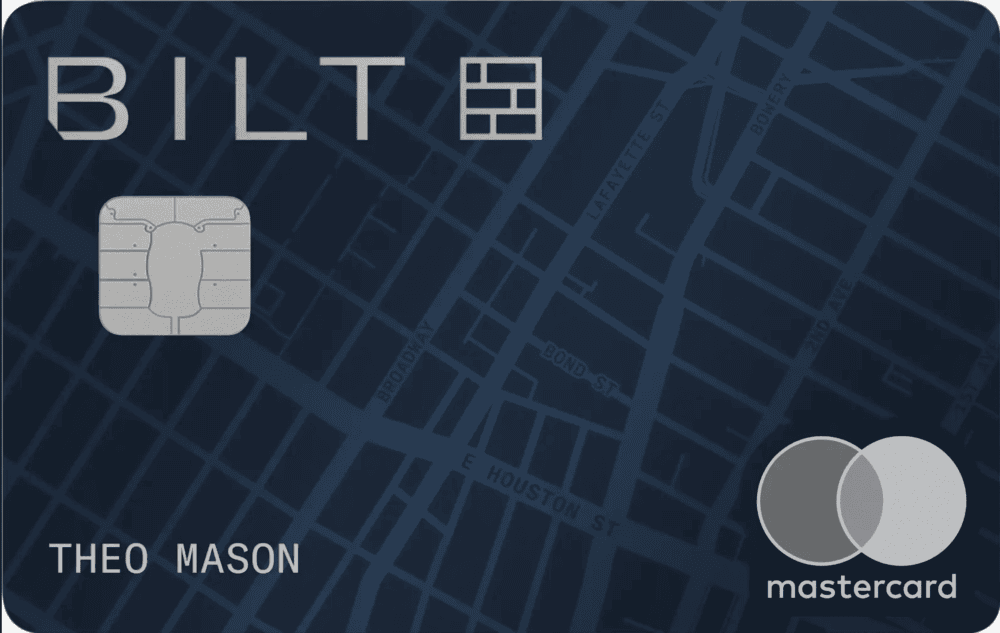
when you apply and are approved. At the end of each calendar, any Bilt Cash balance over $100 will expire.
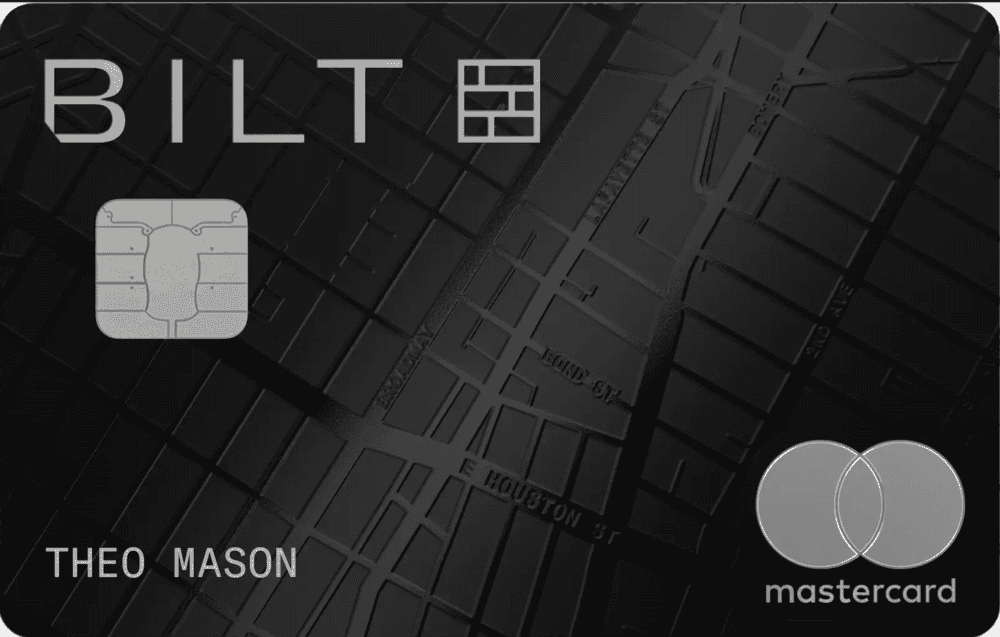
when you apply and are approved. At the end of each calendar, any Bilt Cash balance over $100 will expire.
Annual Fee: $95
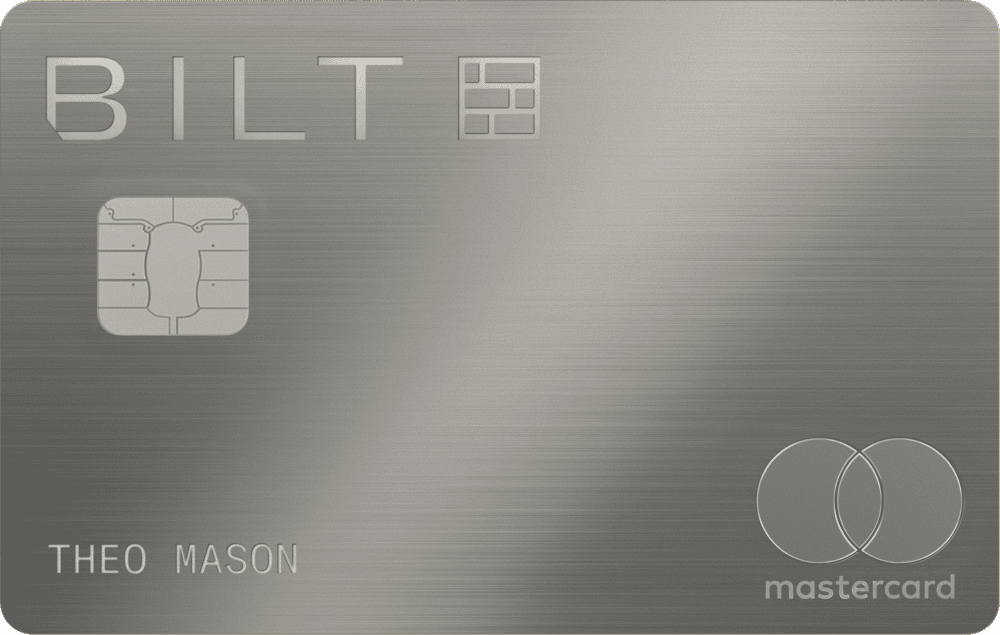
+ Gold Status after spending $4,000 on everyday purchases in the first 90 days + $300 of Bilt Cash. At the end of each calendar, any Bilt Cash balance over $100 will expire.
Annual Fee: $495
Editors Note: Opinions expressed here are author’s alone, not those of any bank, credit card issuer, hotel, airline, or other entity. This content has not been reviewed, approved or otherwise endorsed by any of the entities included within the post.
10xTravel is part of an affiliate sales network and receives compensation for sending traffic to partner sites, such as CreditCards.com. This site may earn compensation when a customer clicks on a link, when an application is approved, or when an account is opened. This compensation may impact how and where links appear on this site. This site does not include all financial companies or all available financial offers. Terms apply to American Express benefits and offers. Enrollment may be required for select American Express benefits and offers. Visit americanexpress.com to learn more. All values of Membership Rewards are assigned based on the assumption, experience and opinions of the 10xTravel team and represent an estimate and not an actual value of points. Estimated value is not a fixed value and may not be the typical value enjoyed by card members.
Editors Note: Opinions expressed here are author’s alone, not those of any bank, credit card issuer, hotel, airline, or other entity. This content has not been reviewed, approved or otherwise endorsed by any of the entities included within the post.
bonus cash back
after you spend $6,000 on purchases in the first 3 months from account opening.
earn 75K bonus miles
once you spend $4,000 on purchases within 3 months from account opening.
bonus points
after you spend $5,000 on purchases in the first 3 months from account opening.
Membership Rewards® Points
after you spend $8,000 in eligible purchases on your new Card in your first 6 months of Card Membership. Welcome offers vary and you may not be eligible for an offer. Apply to know if you’re approved and find out your exact welcome offer amount – all with no credit score impact. If you’re approved and choose to accept the Card, your score may be impacted.