10xTravel is part of an affiliate sales network and receives compensation for sending traffic to partner sites, such as CreditCards.com. This site may earn compensation when a customer clicks on a link, when an application is approved, or when an account is opened. This compensation may impact how and where links appear on this site. This site does not include all financial companies or all available financial offers. Terms apply to American Express benefits and offers. Enrollment may be required for select American Express benefits and offers. Visit americanexpress.com to learn more. All values of Membership Rewards are assigned based on the assumption, experience and opinions of the 10xTravel team and represent an estimate and not an actual value of points. Estimated value is not a fixed value and may not be the typical value enjoyed by card members.
Note: Some of the offers mentioned below may have changed or may no longer be available. The content on this page is accurate as of the posting date; however, some of our partner offers may have expired. You can view current offers here.
Your rental or mortgage payment is probably your biggest monthly expense. For most people, that payment disappears into the void without earning a single reward point.
Bilt Rewards exists to change that equation, offering one of the only ways to earn valuable transferable points on housing costs without paying transaction fees.
But here’s the catch—Bilt isn’t simple.
The program uses two separate reward currencies, offers multiple earning paths and requires you to make strategic decisions about how you want to accumulate points. You might find value and outsized rewards in that complexity. Alternatively, you might find it overwhelming and unnecessary.
Here’s everything you need to know to decide if Bilt belongs in your wallet.

How the Bilt Rewards Platform Works
Bilt Rewards operates as a rewards program built around your housing payments. The platform lets you earn points on rental or mortgage payments that you can transfer to more than 20 airline and hotel loyalty programs for award flights, hotel stays and other lucrative travel redemptions.
The program offers three credit cards with different annual fees and earning structures. You can join without a credit card, but cardholders unlock significantly higher earning potential.
Account Creation and Identity Verification
Getting started requires creating an account through the Bilt Rewards platform or mobile app. You’ll provide standard personal information including name, date of birth, address, email and phone number.
Bilt cards are issued by Column N.A. Bank and serviced by Cardless.
Linking Rent Payments to Rewards
Connecting your housing payment to Bilt depends on whether your property participates in the Bilt Rewards Alliance network.
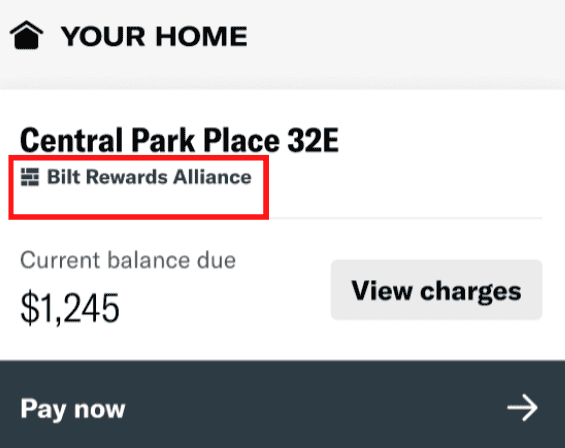
Alliance properties, which covers more than 5 million homes, integrate directly with Bilt through the Bilt app or website. You’ll need to ensure that your home address is connected to Bilt as shown below.
For non-Alliance properties, Bilt offers BillPay. You submit payments through the app, and Bilt pays your landlord via check, ACH or their preferred method. This service is free for cardholders.
Mortgage payments work similarly through direct partnerships or BillPay. Housing payments don’t use your credit line—money comes directly from your linked bank account.
Bilt Rewards Benefits and Earning Opportunities
The Bilt Rewards program offers three credit cards, each with different annual fees and earning structures, including:
- Bilt Blue Card ($0 annual fee, see rates and fees): Earns 1X Bilt Points per dollar on everyday spend.
- Bilt Obsidian Card ($95 annual fee, see rates and fees): Earns 1X Bilt Points per dollar on non-bonus category every day spend purchases, 3X points on your choice of dining or groceries (groceries capped at $25,000 annually, 1X points thereafter; your 3X category choice remains in effect for the entire calendar year.), and 2X points on travel.
- Bilt Palladium Card ($495 annual fee, see rates and fees): Earns 2X Bilt Points per dollar on everyday spend. Comes with Bilt Gold elite status, $400 in annual Bilt Travel portal hotel credits for qualifying Bilt Travel Portal hotel bookings (issued in semiannual $200 credits), $200 in Bilt Cash as an annual credit (up to $100 of Bilt Cash earned rolls over to the next year) and Priority Pass lounge access.
Bilt points never expire, unless your account is inactive for 18 months. This gives you time to accumulate enough points for lucrative redemptions without worrying about losing value.
Earning Points on Rent and Mortgage
Bilt’s housing rewards work through two separate earning paths. You choose one when you activate your card, and you can switch between them monthly (changes take effect the following month).
The first option is to earn Bilt Cash.
Under this option, you earn 4% in Bilt Cash on everyday card purchases in addition to your base Bilt points. You can then use that Bilt Cash to unlock points on housing payments at a conversion rate of $30 in Bilt Cash for every 1,000 Bilt points (up to $100 of Bilt Cash earned rolls over to the next year).
For instance, let’s say your rent is $2,000 per month. To earn 2,000 points on that payment, you need $60 in Bilt Cash. Since you earn 4% Bilt Cash on everyday spending, you’d need to put $1,500 in spend on your card during that billing cycle to generate the required $60 in Bilt Cash. And by doing so, you’d earn 1X points per dollar spent on your rent.
While this sounds complex, the easiest way to work out how much you need to spend to earn 1X points on your housing payment is to simply calculate 75% of it.
For instance, if your mortgage payment is $3,000 per month, you’d need to charge a total of $2,250 to your card in non-housing purchases. This would earn you $90 worth of Bilt Cash, which is the exact amount required to earn 3,000 points on your $3,000 mortgage payment.
If you were to spend less than this, such as $1,500 in non-housing purchases, you’d earn $60 in Bilt Cash, meaning that you’d earn 2,000 points on your $3,000 mortgage payment.
While Bilt Cash sounds complex, its advantage is flexibility. You can redeem Bilt Cash across Bilt’s entire ecosystem as well as for housing payments, including for:
- Monthly credits toward Grubhub and select dining partners
- Lyft ride credits (up to $10 monthly)
- Hotel bookings through the Bilt Travel portal
- Fitness class bookings
- BLADE airport flights and Blacklane rides
- Point accelerator on everyday spending: additional 1X bonus points on all everyday spend for the next $5,000 following activation; exclusively available to Obsidian and Palladium cardholders (costs $200 in Bilt Cash with a maximum of five activations annually; expires after you spend $5,000 on everyday purchases or calendar year-end)
- Temporary status tier boosts during Rent Day for better transfer bonuses
Bilt Cash operates as a secondary currency alongside Bilt points. Think of Bilt points as your long-term travel currency that transfers to partners while Bilt Cash provides immediate value within Bilt’s ecosystem.
Everyone earns $50 in Bilt Cash for every 25,000 Bilt points earned toward status.
The major restriction is that Bilt Cash expires on Dec. 31 of each year, but you can roll over up to $100. This makes it fundamentally different from Bilt points, which never expire (unless your account is inactive for 18 months).
The second earning option allows you to earn up to 1.25X points on your housing spend.
This earning system automatically awards points on your housing payments as a percentage of how much you spend on everyday purchases.
Bilt’s earning tiers work as follows:
| Points multiplier on housing payments | Percentage of non-housing spend required (relative to housing spend) |
|---|---|
| 0.5X | 25% |
| 0.75X | 50% |
| 1X | 75% |
| 1.25X | 100% |
If you don’t manage to hit the 25% threshold, you’ll receive a baseline of 250 points on your housing payment instead of earning a specific multiplier.
If your housing payment was $2,000 per month, you’d earn the following number of points on that spending:
- 2,500 points if you spent $2,000 on non-housing purchases
- 2,000 points if you spent $1,500 on non-housing purchases
- 1,500 points if you spent $1,000 on non-housing purchases
- 1,000 points if you spent $500 on non-housing purchases
Keep in mind that these are the points you’d earn on your housing payment and are in addition to the points earned on your non-housing expenditure.
The key difference is that this path rewards high spenders who naturally put most of their expenses on their credit card while the Bilt Cash path offers more flexibility for people with variable spending patterns.
Bonus Categories and Spend Multipliers
Everyday earning rates depend on your card:
- Bilt Blue Card: 1X points per dollar spent on everyday spend
- Bilt Obsidian Card: 3X points per dollar spent on dining or groceries (3X points for groceries are capped at $25,000 in spend, 1X points thereafter), 2X points on travel and 1X points on all other everyday spend
- Bilt Palladium Card: 2X points per dollar on everyday spend
If you select the Bilt Cash earning path, you’ll earn 4% Bilt Cash on top of all base points.
When it comes to earning points on housing payments, all cards are equal—they offer either 4% in Bilt Cash or up to 1.25X points.
Regardless of the card you choose, you’ll need to charge 75% worth of your housing payment in non-housing purchases to your card to be able to earn 1X points on your housing payment when using Bilt Cash or the tiered system. If you want to boost this to 1.25X points, your everyday non-housing expenditure needs to be equal to or more than your housing payment.
Therefore, the cards differentiate themselves based on their bonus spending categories and cardholder perks.
If you want a card that earns a return on housing costs without paying an annual fee, the Bilt Blue Card is a solid option. It earns 1X points on everyday spend.
If dining or groceries make up a large portion of your spending, you could earn up to 75,000 Bilt points by charging these purchases to the Bilt Obsidian card. You’ll also earn a further 2X points on travel purchases, making it a great option for frequent travelers.
Offsetting the Obsidian Card’s $95 annual fee should be easy enough for those who can maximize its bonus spending categories. For instance, you’d need to spend $2,534 in its 3X category to break even on the annual fee, assuming a redemption value of 1.25 cents per point.
If housing costs are one of your top expenses and you want to aggregate all your spending on one card, the Bilt Palladium could work for you. You’ll earn 2X points on every dollar spent as well as a hefty welcome offer, and you can centralize all your spending on the card to ensure you get 1.25X points on your housing payments.
To offset the Palladium’s annual fee using the 2X point category alone, you’d need to charge $19,800 to the card (at a value of 1.25 cents per point). However, in reality, you’ll need to spend less than this to break even because you’ll also be earning 0.5X to 1.25X points on housing costs.
Promotional and Limited-Time Earning Opportunities
Bilt runs monthly Rent Day promotions on the first of each month featuring transfer bonuses to select partners, typically ranging from 25% to 125% additional points.
These can be particularly lucrative if you’re looking to redeem your points with an eligible transfer partner, increasing their value.
Bilt Program Review: Fees, Limitations and Restrictions
Here’s a breakdown of Bilt’s fees.
Rent and Mortgage Payment Fees and Processing Costs
Bilt cardholders pay zero transaction fees on housing payments made through its platform. On a $2,000 monthly rent payment, this saves roughly $60 compared to third-party services like Plastiq that charge 2.99% in processing fees.
Your housing payment is processed via ACH through your connected bank account, meaning it doesn’t affect your credit line.
If you’re not a Bilt cardholder or if you’re paying for an out-of-network property, you’ll pay $9.95 per transaction for debit cards and 3% for third-party credit cards.
Earning Caps and Category Limits
There is no annual cap on housing payment rewards, meaning that your earning potential is restricted only by your spending volume.
The Obsidian Card caps its 3X category for groceries at $25,000 in annual spend, earning 1X points thereafter. That still allows you to earn up to 75,000 points annually before hitting the cap.
Comparing the Bilt Loyalty Program to Other Rewards Programs
Bilt offers a unique rewards program, but how does it compare to other travel rewards programs?
Versus General Travel Rewards Cards
Bilt offers three cards that focus on rewarding housing costs while also offering scaling benefits depending on the annual fee.
For instance, the $95 Bilt Obsidian Card (see rates and fees) comes with an annual $100 hotel credit, issued in two $50 credits, for qualifying Bilt Travel Portal hotel bookings while the $495 Bilt Palladium Card (see rates and fees) offers a $400 hotel credit (issued in two $200 credits), $200 of Bilt Cash and complimentary Priority Pass Select membership.
Bilt is the only card provider to offer the ability to earn points on your housing costs. However, the main downside to Bilt’s cards are their lack of premium perks and diversified bonus spending categories as well as their restrictive spending requirements.
To get 1X to 1.25X points on your housing costs, you need to spend between 75% and 100% on everyday non-housing purchases. This is a large spending commitment that for many cardholders would force them to centralize all spending on their Bilt card.
For this reason, Bilt’s cards work best for those who either want only one credit card and don’t mind centralizing their spending or for those with high monthly expenditure.
In contrast, other premium travel cards offer more diversified bonus spending categories, a wider range of useful cardholder perks and far simpler rewards ecosystems. This makes it easier to form a card strategy that involves multiple cards and earn numerous welcome offers rather than having to centralize all spending on one card.
Versus Rent-Focused Cashback Programs
Third-party services like Plastiq allow paying rent with any credit card for 2.99% in processing fees. The math rarely works out favorably, unless you’re leveraging your spend toward earning a welcome offer.
For instance, a 2% cashback card paying $2,000 in rent through Plastiq would pay $60 in fees to earn $40 back, working out to a net loss of $20 per month.
Bilt’s fee structure changes the calculation because every point earned represents pure value rather than value minus transaction costs. For a $2,500 monthly housing payment earning 1.25X points per dollar spent (3,125 points per month), that’s 37,500 annual points worth at least $468 if redeemed through Bilt’s portal at a value of 1.25 cents apiece—all without paying a dollar in transaction fees.
Are You Built for Bilt Rewards?
Bilt is not a universal win. Its value depends heavily on how large your housing payment is relative to your everyday spend and how willing you are to structure spending around one ecosystem.
At its best, Bilt turns an otherwise unrewarded expense into a significant source of transferable points. At its worst, it adds complexity while pushing out more flexible or lucrative card strategies.
Renters and Mortgage Holders Who Pay High Monthly Housing Costs
If housing represents your largest monthly expense, Bilt deserves a closer look. The first step is estimating realistic annual value.
Multiply your monthly rent or mortgage by 12, then apply a conservative earning rate of 1X points. For a $2,500 monthly payment, that’s 30,000 points per year. At a modest 1.25 cents per point, that’s roughly $375 in annual value before factoring in any points earned on everyday spend or transfer partner redemptions.
If you can consistently hit the 100% non-housing spend threshold and earn 1.25X points on housing, the math improves quickly. The same $2,500 monthly payment would generate 37,500 points annually if you simultaneously spent $2,500 on monthly non-housing expenses.
That additional $2,500 in monthly non-housing spend would also earn you between 1X and 3X points per dollar spent, depending on the card held and your spending mix. At the minimum, you’d earn a total of 67,500 points per year, worth at least $843. If you maxed out the Obsidian Card’s 3X multiplier on groceries, you could earn a total of 112,500 points per year—worth at least $1,406 in travel value—on housing and non-housing expenses combined.
The key question is not whether Bilt can generate value, but whether your spending profile naturally supports the thresholds without forcing behavior changes.
Renters and Homeowners Who Already Optimize Travel Rewards
For experienced points earners running multi-card strategies, Bilt is best viewed as a specialist tool rather than a centerpiece. Its biggest advantage is that it fills a gap most other cards ignore: housing payments. That can make it an attractive card to add to your portfolio to complement your overall strategy.
However, the spending thresholds introduce opportunity cost. Every dollar routed to Bilt to unlock housing points is a dollar not earning higher multipliers or welcome offers elsewhere.
That’s where having high monthly spend is important if you’re hoping to add Bilt to your card portfolio.
For instance, if you spend $8,000 per month, $2,500 of which goes toward your mortgage payment, you could realistically charge $5,000 to a Bilt card and still have $3,000 leftover to charge to other credit cards. The higher your monthly spend, the better the math works in your favor.
Who May Want to Skip the Bilt Rewards Program
Bilt’s not for everyone. Here’s who Bilt won’t work for.
Non-Housing-Payment Users
If you don’t pay rent or a mortgage, Bilt loses its core differentiator.
At that point, you’re left with a card offering unremarkable earning rates, limited bonus categories and perks that are weaker than competing travel cards at similar annual fees.
Low-Spend or Infrequent Housing Payers
If your housing payment is relatively small or irregular, rewards accumulation will be slow.
Someone paying $900 in rent will earn at most 10,800 points annually at 1X points per dollar, and only if they meet the spending thresholds. That’s unlikely to justify restructuring spend or adding another program to manage, especially when welcome offers elsewhere can generate similar or even greater point totals with far less effort.
Bilt is most compelling when housing costs are both large and predictable.

Bilt Rewards Program Transfer Partners and Real-World Redemption
Bilt points transfer to more than 20 airline and hotel loyalty programs, almost all at 1:1 ratios. Most transfers process immediately or within 48 hours, giving you fast access to partner award inventory.
Bilt Rewards transfer partners compete with the best and easily match heavyweights like American Express Membership Rewards, Chase Ultimate Rewards and Capital One Rewards when it comes to diversity of choice and transfer ratios.
Airline Partners
Bilt points transfer to the following airline loyalty programs at the following rates:
- Aer Lingus AerClub: 1:1
- Air Canada Aeroplan: 1:1
- Air France-KLM Flying Blue: 1:1
- Atmos Rewards: 1:1
- Avianca LifeMiles: 1:1
- Cathay Pacific Asia Miles: 1:1
- Club Iberia Plus: 1:1
- Emirates Skywards: 1:1
- Etihad Guest Miles: 1:1
- JAL Mileage Bank: 1:1
- Qatar Airways Privilege Club: 1:1
- Southwest Rapid Rewards: 1:1
- Spirit Airlines Free Spirit: 1:1
- TAP Air Portugal Miles&Go: 1:1
- The British Airways Club: 1:1
- Turkish Airlines Miles&Smiles: 1:1
- United MileagePlus: 1:1
- Virgin Atlantic Flying Club: 1:1
If you have Bilt Blue status, you need to transfer a minimum point of 2,000 Bilt Points. If you have Silver, Gold or Platinum Bilt Status, your transfer minimum is 1,000 Bilt points.
Bilt’s airline transfer partners are highly valuable, allowing your points to go even further.
You can transfer your points to Air Canada Aeroplan and Avianca LifeMiles for lucrative Star Alliance partner award redemptions.
For powerful SkyTeam redemptions, you can transfer your Bilt points to Air France-KLM Flying Blue and Virgin Atlantic Flying Club.
And for competitive Oneworld partner award bookings, your Bilt points will go far with Atmos Rewards and Cathay Pacific Asia Miles.
Hotel Partners
If you’d prefer to use your points for hotel stays, you’re in luck.
Bilt points transfer to five hotel loyalty programs, including:
- Accor Live Limitless: 3:2
- Hilton Honors: 1:1
- IHG One Rewards: 1:1
- Marriott Bonvoy: 1:1
- World of Hyatt: 1:1
This provides you with access to three of the most powerful hotel loyalty programs, including World of Hyatt, our all-time favorite hotel program.
With these brands on offer, you’ll never be stuck when searching for somewhere to stay.
Common Pitfalls and Mistakes to Avoid
Bilt’s complexity creates room for error. Most frustrations reported by users stem from misunderstanding the mechanics of the program.
Failed Rent Tracking or Missing Points
The most common issue is housing payments not tracking correctly.
Always confirm that your property is correctly linked in the Bilt app and that your payment method is active before submitting a payment.
If points don’t post, document the transaction and contact Bilt support promptly. Escalation typically resolves legitimate issues, but delays can occur if details are incomplete.
Transferring Points Without a Plan
Once Bilt points leave the platform, they can’t be reversed.
Before transferring, verify award availability, transfer minimums and partner rules. A speculative transfer can easily lock points into a program where redemption options are limited or devalued.
This is especially important during Rent Day transfer bonuses, which can encourage impulsive transfers.
Choosing the Wrong Housing Earning Path
Selecting between Bilt Cash and spending tiers is a monthly decision, and it’s one that affects earning outcomes.
As a rule of thumb, if your non-housing spend fluctuates or is below 75% of your housing payment, Bilt Cash offers more flexibility and predictability. If your spending consistently meets or exceeds housing costs, the tiered path can deliver higher point returns.
Because changes take effect the following month, proactive planning matters.
How 10xTravel Evaluates the Bilt Rewards Program
Here at 10xTravel, we think that the Bilt loyalty program leaves a lot to be desired.
Bilt’s rewards ecosystem is overly complex and forces cardholders into funneling a lot of their spend through its cards. While Bilt offers a unique way to earn points on housing costs, it comes with significant opportunity cost.
That said, for high spenders or those happy to immerse themselves in Bilt’s ecosystem, a card such as the Bilt Palladium Card can offer a solid return on investment. Even the Obsidian and the Blue cards have their place for certain spending profiles.
Bilt points are also highly valuable, given Bilt’s lucrative list of transfer partners.
Hopefully, Bilt will streamline its program in the future to make things simpler for its users.
Next Steps for Deciding if Bilt Fits Your Strategy
Before applying for a Bilt Card, run the numbers honestly.
Estimate your housing payment, your realistic non-housing spend and how much flexibility you have to shift spending. Compare the projected annual point earnings to what you could earn elsewhere with less effort.
As you’ve seen in this Bilt Rewards review, Bilt isn’t for everyone. But for the right user, it turns the single biggest expense on the balance sheet into a long-term travel asset.
New to the world of points and miles? The Chase Sapphire Preferred® Card is the best card to start with.
With a bonus of Earn 75,000 bonus points after you spend $5,000 on purchases in the first 3 months from account opening. , 5x points on travel booked through the Chase TravelSM Portal and 3x points on restaurants, streaming services, and online groceries (excluding Target, Walmart, and wholesale clubs), this card truly cannot be beat for getting started!
Editors Note: Opinions expressed here are author’s alone, not those of any bank, credit card issuer, hotel, airline, or other entity. This content has not been reviewed, approved or otherwise endorsed by any of the entities included within the post.
10xTravel is part of an affiliate sales network and receives compensation for sending traffic to partner sites, such as CreditCards.com. This site may earn compensation when a customer clicks on a link, when an application is approved, or when an account is opened. This compensation may impact how and where links appear on this site. This site does not include all financial companies or all available financial offers. Terms apply to American Express benefits and offers. Enrollment may be required for select American Express benefits and offers. Visit americanexpress.com to learn more. All values of Membership Rewards are assigned based on the assumption, experience and opinions of the 10xTravel team and represent an estimate and not an actual value of points. Estimated value is not a fixed value and may not be the typical value enjoyed by card members.
Editors Note: Opinions expressed here are author’s alone, not those of any bank, credit card issuer, hotel, airline, or other entity. This content has not been reviewed, approved or otherwise endorsed by any of the entities included within the post.
bonus cash back
after you spend $6,000 on purchases in the first 3 months from account opening.
earn 75K bonus miles miles
once you spend $4,000 on purchases within 3 months from account opening.
bonus points
after you spend $5,000 on purchases in the first 3 months from account opening.
Membership Rewards® Points
after you spend $8,000 in eligible purchases on your new Card in your first 6 months of Card Membership. Welcome offers vary and you may not be eligible for an offer. Apply to know if you’re approved and find out your exact welcome offer amount – all with no credit score impact. If you’re approved and choose to accept the Card, your score may be impacted.