


10xTravel is part of an affiliate sales network and receives compensation for sending traffic to partner sites, such as CreditCards.com. This site may earn compensation when a customer clicks on a link, when an application is approved, or when an account is opened. This compensation may impact how and where links appear on this site. This site does not include all financial companies or all available financial offers. Terms apply to American Express benefits and offers. Enrollment may be required for select American Express benefits and offers. Visit americanexpress.com to learn more. All values of Membership Rewards are assigned based on the assumption, experience and opinions of the 10xTravel team and represent an estimate and not an actual value of points. Estimated value is not a fixed value and may not be the typical value enjoyed by card members.
Many travelers mistakenly believe that there are only two types of flight itineraries: one-way and round-trip. However, open-jaw itineraries are a third type that can be used to add even more flexibility to your travel plans.
Essentially, an open-jaw itinerary can refer to either:
- An itinerary that starts and ends in different cities
- Example: San Francisco – Seoul, Seoul to Los Angeles
- An itinerary where your return flight departs from a different city than you arrived in
- Example: Miami – Medellin, Bogota – Miami
In the second example, you’d have to travel between Medellin (where you arrived) and Bogota (where your return flight departs from) by land, presumably.
As you might imagine, these types of itineraries can be great for travelers who want to explore a country or region without having to backtrack to the airport they arrived in to catch their return flight home. This allows you to see more, save time and save money (since these open-jaw itineraries are often cheaper than booking two one-way flights.)
In this article, we’re going to explain how open-jaw flights work, the advantages of booking an open-jaw ticket and how to book open-jaw flights.
Why Smart Travelers Are Choosing Multi-City Routes
An open-jaw itinerary is a flight itinerary that either starts and ends in different cities or departs from a different city than the initial flight arrived in. The “jaw” refers to the distance between the arrival and departure airports.
These open-jaw flights are becoming increasingly popular among savvy travelers for several reasons. In certain scenarios, booking open-jaw flights instead of round-trip itineraries or one-way flights can offer cost savings, increased flexibility and the opportunity to see more of a country or region than you might with another type of itinerary.
5 Game-Changing Benefits of Open-Jaw Itineraries
To get a greater understanding of the best times to use open-jaw flights, let’s take a look at five game-changing benefits of open-jaw itineraries.
1. Cost savings.
Most airlines price round-trip itineraries lower per segment than one-way flights. For instance, if you were to book a round-trip KLM flight between New York and Amsterdam, it would be cheaper than if you booked a one-way flight from New York to Amsterdam and then another one-way flight from Amsterdam to New York.
With most airlines, the same logic applies to open-jaw flights. So, booking an open-jaw flight will often cost less than booking two one-way flights on the same route. For example, booking a KLM-operated New York – Amsterdam – Boston open-jaw flight itinerary would cost less than booking a one-way flight from New York to Amsterdam and then another one-way flight from Amsterdam to Boston.
It’s worth noting, however, that these cost savings don’t apply to every airline. Certain low-cost carriers and U.S. carriers price some flights per segment and don’t give discounts for booking round-trip or open-jaw flights.
2. Saves time backtracking.
One major advantage of booking open-jaw flights instead of round-trip flights is that an open-jaw itinerary can save you time backtracking through regions that you’ve already visited. Rather than traveling a certain distance from your arrival airport and then having to circle back to catch your return flight, an open-jaw itinerary allows you to continue moving forward without having to backtrack to catch your return flight.
For instance, let’s say that you flew from Miami to Barcelona and that, once in Barcelona, you wanted to take a train from Barcelona to Madrid. If you were to book a round-trip ticket, you’d have to backtrack to Barcelona to catch your return flight. However, using the open-jaw option, you could book your return flight out of Madrid instead. Thus, you wouldn’t need to backtrack and would have more time to explore new regions.
3. Visit multiple destinations for the same price.
As they say, variety is the spice of life. And, if given the choice, many travelers would rather experience two different cities than just one city. Using open-jaw flights, you can give yourself the opportunity to visit two destinations for the price of one.
For example, you could book a round-trip flight to Buenos Aires, Argentina, and spend your entire trip in that single city. On the other hand, you could book an open-jaw ticket that arrives in Buenos Aires and departs from Montevideo, Uruguay. In that case, you could spend the first part of your trip in Buenos Aires, take a ferry ride across the beautiful Rio de la Plata to Montevideo, experience Uruguay’s capital city and then fly home without having to backtrack.
4. Depart and return in different cities.
In some cases, departing and returning to different cities can align much better with your schedule. Thus, booking an open-jaw flight could save you money and time.
For example, let’s say that you live in Detroit and you’re spending two weeks in Lisbon, Portugal. However, at the end of those two weeks, you have to go to Chicago for a wedding. In this case, you could book a Detroit – Lisbon – Chicago open-jaw itinerary.
Once again, this is a cheaper alternative to booking a one-way flight from Detroit to Lisbon and another one-way flight from Lisbon to Chicago. It’s also cheaper and more convenient than booking a round-trip itinerary between Detroit and Lisbon and another round-trip itinerary between Detroit and Chicago.
5. Experience other forms of transportation.
For many people, land or sea travel can be one of the best parts of an adventure. And, when booking open-jaw flights, you’ll often need to travel by land or sea between your arrival and departure airports. While this may sound inconvenient to some, it may sound like an opportunity for adventure to others.
For example, one of the finest railway systems is the Palace on Wheels in India. This train features luxurious cabins, gourmet dining, state-of-the-art facilities and more. Truly, taking this train is a destination in and of itself.
So, using an open-jaw flight itinerary, you could book a flight from the U.S. to Delhi, take the Palace on Wheels train to Jaipur and then take a flight from Jaipur back to your home city in the U.S.
How Much Can You Really Save?
Some airlines (low-cost airlines and some U.S. airlines in particular) price round-trip and open-jaw flights per segment. In these cases, you wouldn’t save any money by purchasing open-jaw flights rather than purchasing two one-way flights.
However, with the majority of airlines in the world (particularly international airlines), you’ll get a significant discount per segment when purchasing open-jaw flights. However, the exact discount you’ll receive depends on the particular flights that you’re booking.
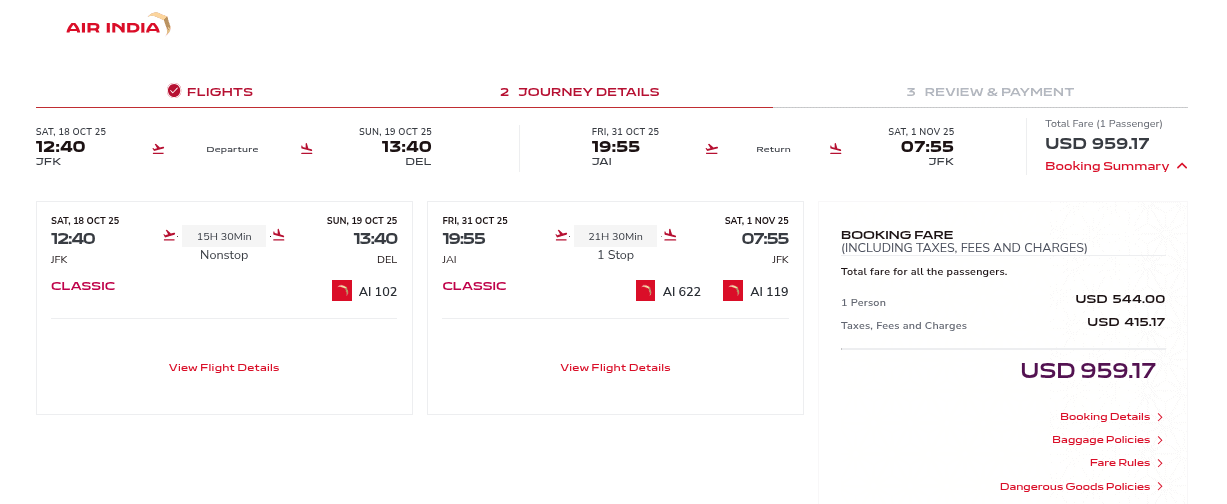
As an example, we looked into the price of booking the following economy-class Air India open-jaw itinerary:
- New York (JFK) – Delhi (DEL)
- Jaipur (JAI) – New York (JFK)
If you were to book these flights as an open-jaw itinerary, it would cost about $959.
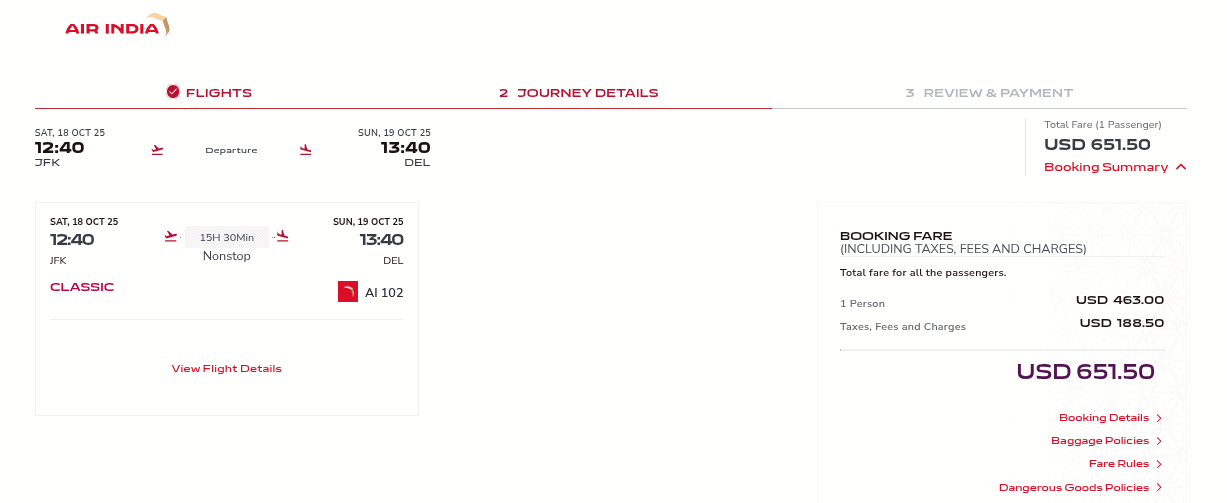
If you were to book these same flights individually as one-way flights through the Air India website, the first segment from New York to Delhi would cost you about $652.
And the second segment from Jaipur to New York would cost you 48,683 Indian Rupee (about $555).
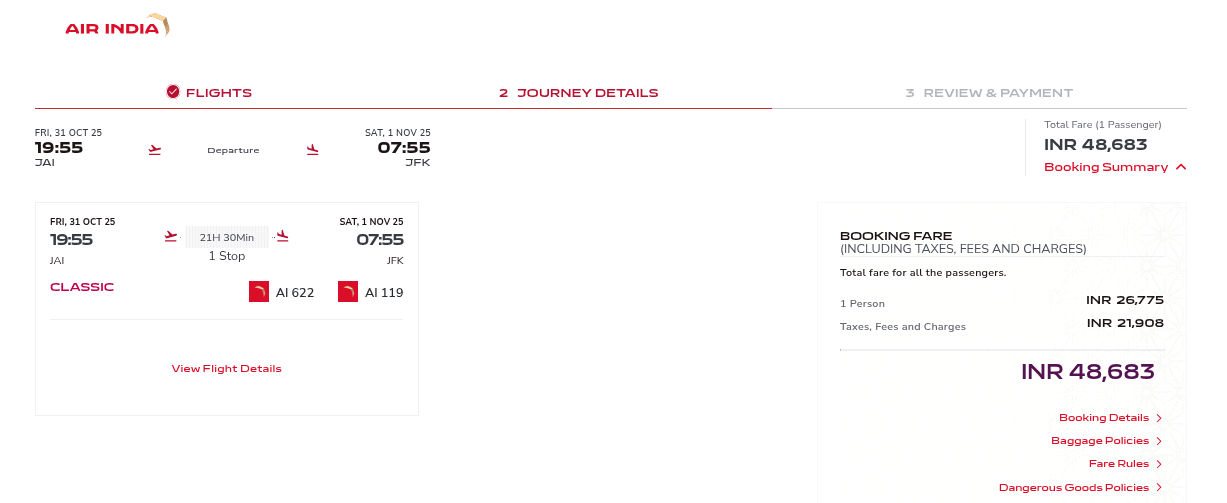
Thus, by booking these flights separately as one-way flights, you’d spend a total of about $1,207. On the other hand, by booking open-jaw flights on this route, you’d spend about $959. That equates to savings of $248 by booking the open-jaw flights, which is certainly a significant amount of money.
What’s The Best Way to Book These Complex Routes?
When searching for open-jaw flights, you’ll typically want to use the multi-city search function, which is available on most airlines’ websites and most credit card travel booking sites.
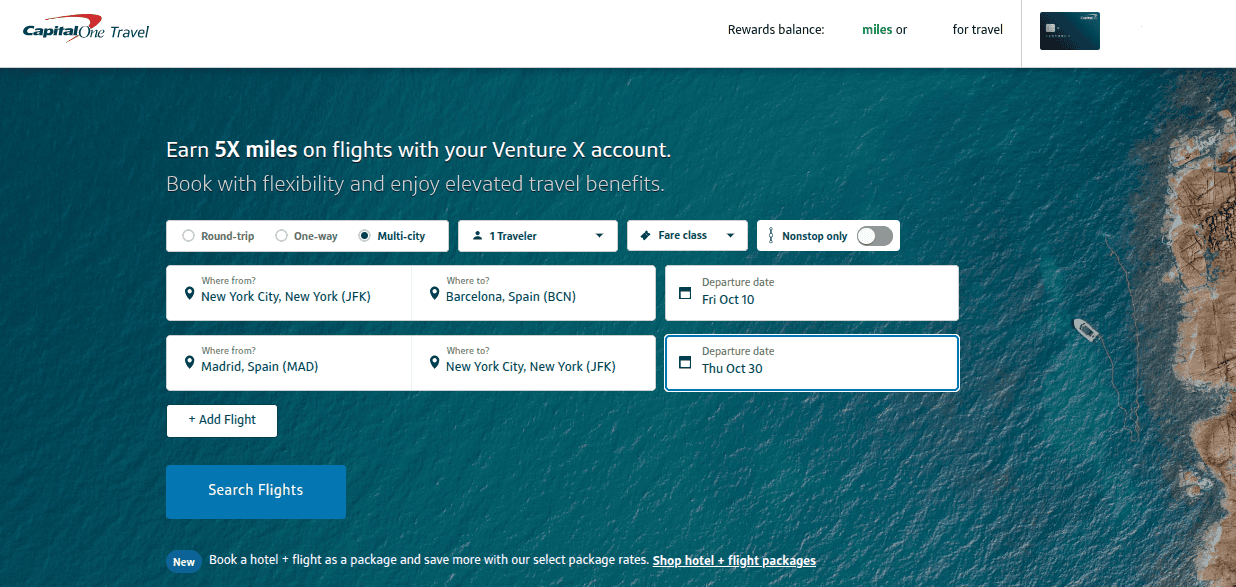
You’ll then need to enter the departure and arrival airport of both your outbound flight and return flight as well as the travel dates for each segment. For instance, in the example above, the itinerary is as follows:
- Outbound: New York (JFK) – Barcelona (BCN)
- Return: Madrid (MAD) – New York (JFK)
Of course, if you want to book open-jaw flights at a low out-of-pocket cost, you should consider booking with points or miles. Through credit card travel booking portals, you can use points to cover the entire cost or a portion of the cost of an open-jaw itinerary.
Alternatively, you can book open-jaw flights with airline miles through frequent flyer programs. And, sometimes, rather than using a credit card travel booking portal to book open-jaw flights, you could transfer your credit card points to a frequent flyer program and book those open-jaw flights at an even better rate.
Which Airlines Offer the Best Open-Jaw Deals?
When booking open-jaw flights, some frequent flyer programs are much better than others. In fact, some airlines don’t even allow you to book open-jaw itineraries through their frequent flyer programs.
However, other frequent flyer programs offer generous rates and very flexible rules when it comes to booking open-jaw flights with miles. Let’s take a look at some of the best airlines’ frequent flyer programs through which to book open-jaw awards.
ANA Mileage Club
Mileage Club, the frequent flyer program of Japanese airline ANA (All Nippon Airways), has some of the most generous rules when it comes to booking flexible award itineraries. For one, the program allows open-jaw flights at no additional cost as long as the itinerary meets the following conditions:
- If the original departure point and final arrival point aren’t the same, they must be in the same country.
- If the arrival point of the first flight segment and the departure point of the second flight segment aren’t the same, they must be in the same area.
Here are the areas defined by ANA Mileage Club:
- Area 1: North America, Hawaii, etc.
- Area 2: Europe, Middle East, Africa, Russia (west of Ural Mountains), etc.
- Area 3: Japan, South Korea, China, Southeast Asia, South Asia, Southwest Pacific, Russia (east of Ural mountains), etc.
So, for instance, you could book an itinerary with a segment from New York to Marrakesh and another segment from Marrakesh to Denver for no additional charge because both New York and Denver are in the same country. However, you wouldn’t be able to book an itinerary with a segment from New York to Marrakesh and another segment from Marrakesh to Toronto for no additional charge because New York and Toronto aren’t in the same country.
You could, on the other hand, book an open-jaw flight itinerary with a segment from Amsterdam to New York and another segment from Toronto to Amsterdam because New York and Toronto are both part of Area 1.
Even better, the ANA Mileage Club allows you to add one free stopover (of more than 24 hours) on international round-trip or open-jaw award flight itineraries. Stopover rules depend on the award type and origin; for some ANA awards, stopovers aren’t permitted when the itinerary departs Japan.
So, for instance, you could book an itinerary with an outbound segment between Los Angeles and Bangkok that includes a stopover in Tokyo and a return segment from Ho Chi Minh City to Los Angeles. Thus, you could spend a few days in Tokyo, travel to Bangkok and spend a few days there, take ground transportation or a cheap flight to Ho Chi Minh City and stay there a few days and then fly back home to Los Angeles. This wouldn’t require any additional miles beyond what a basic round-trip award itinerary between Los Angeles and Bangkok would cost (except the price of travel between Bangkok and Ho Chi Minh City).
Air Canada Aeroplan
Another great frequent flyer program for booking flexible open-jaw flights is Air Canada Aeroplan. For one, this program generally has very flexible rules when it comes to open-jaw itineraries as well as good rates on these types of awards.
Air Canada Aeroplan also allows you to add a stopover (outside of the U.S. and Canada only) to each direction of travel for an additional 5,000 Aeroplan points. So, for an open-jaw award itinerary, you could add a stopover to the outbound flight plus another stopover to the inbound flight for a total of 10,000 points.
So, for example, if you were to book an open-jaw award with an outbound route from Montreal (YUL) to Milan (MXP) and an inbound route from Geneva (GVA) to Montreal (YUL), you could potentially add a stopover in Dublin (DUB) on the outbound flight and a stopover in Lisbon (LIS) on the inbound flight.
Thus, you could visit a total of four European cities for just 10,000 additional Aeroplan points. Plus, there are many options for ground transportation between Milan and Geneva as well as cheap regional flights.
It’s important to note there are no open-jaws permitted at stopover points.
These stopovers must be at least 24 hours but can be as long as 45 days. So, if you have time to spare, these stopover rules could help you significantly lengthen your trip at a low cost.
Common Pitfalls to Avoid When Planning Your Route
As we’ve shown above, using open-jaw itineraries can often save you a significant amount of money, miles or points. However, if you don’t use these itineraries intelligently, they can actually become more of a hassle than an advantage.
Let’s look at some common pitfalls to avoid when booking open-jaw award itineraries.
Is Ground Transportation Between Cities Worth It?
When taking open-jaw flights, you’ll need to travel between your arrival city and your departure city. For instance, if you book an open-jaw itinerary with an outbound itinerary that arrives in Los Angeles and departs from San Francisco, you’re going to need to figure out how to travel between these two cities at some point between your two flight segments.
The question of whether ground transportation is worth it (instead of flying between these two cities) depends on several questions, including:
- What is the relative cost of flying versus ground transportation?
- How much longer will ground transportation take than flying?
- Will utilizing ground transportation be enjoyable and/or scenic?
Considering these questions as well as others, you can weigh the pros and cons of flying between your point of arrival and point of departure or using ground transportation.
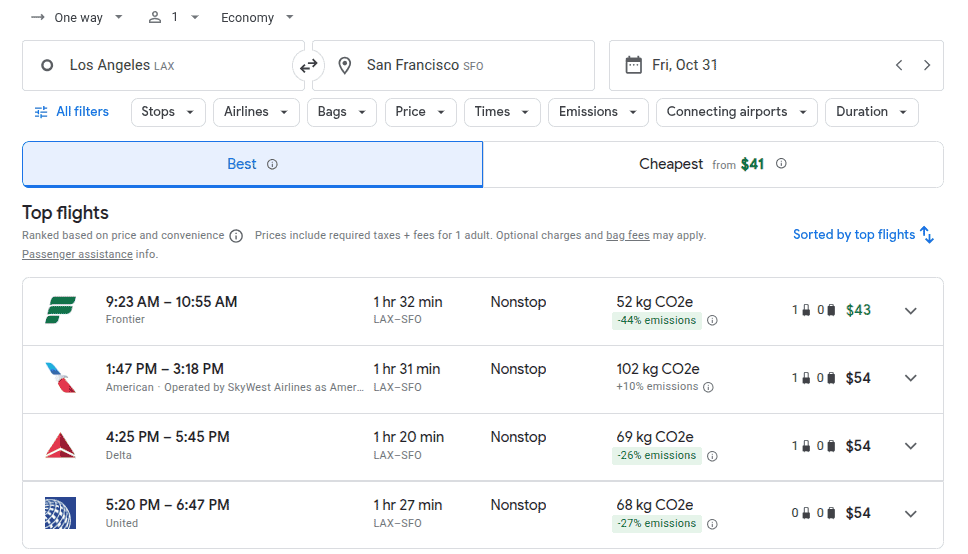
In the example above in which you need to travel between Los Angeles and San Francisco, you could choose to take a cheap flight between these two cities. We found flights on several U.S. airlines in for around $50, which is very cheap.
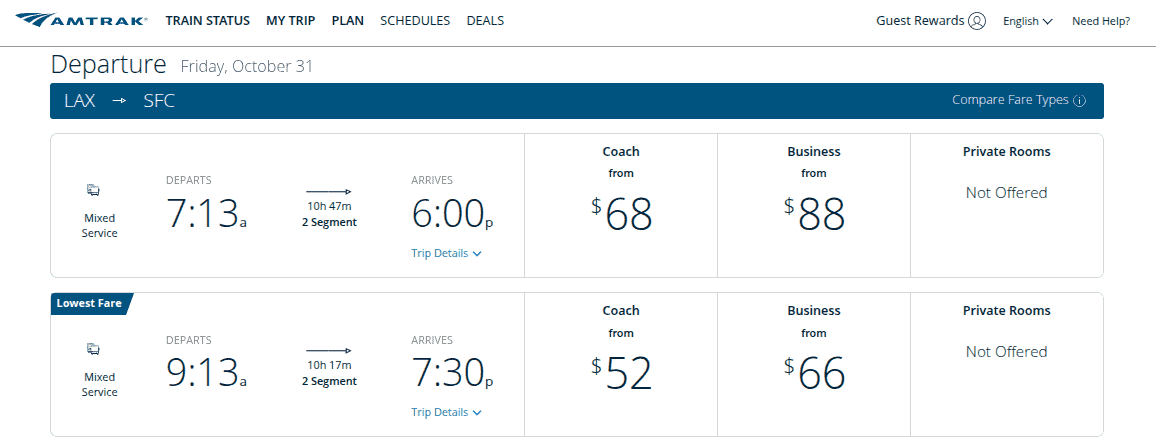
Another option for traveling between these two cities is to take the Amtrak Coast Starlight train line, which offers dramatic views of the U.S. West Coast and is considered one of the most scenic train routes in North America. Tickets for this train ride when we searched cost as little as $52 in Coach and $66 in Business and the duration of the ride is around 10 hours.
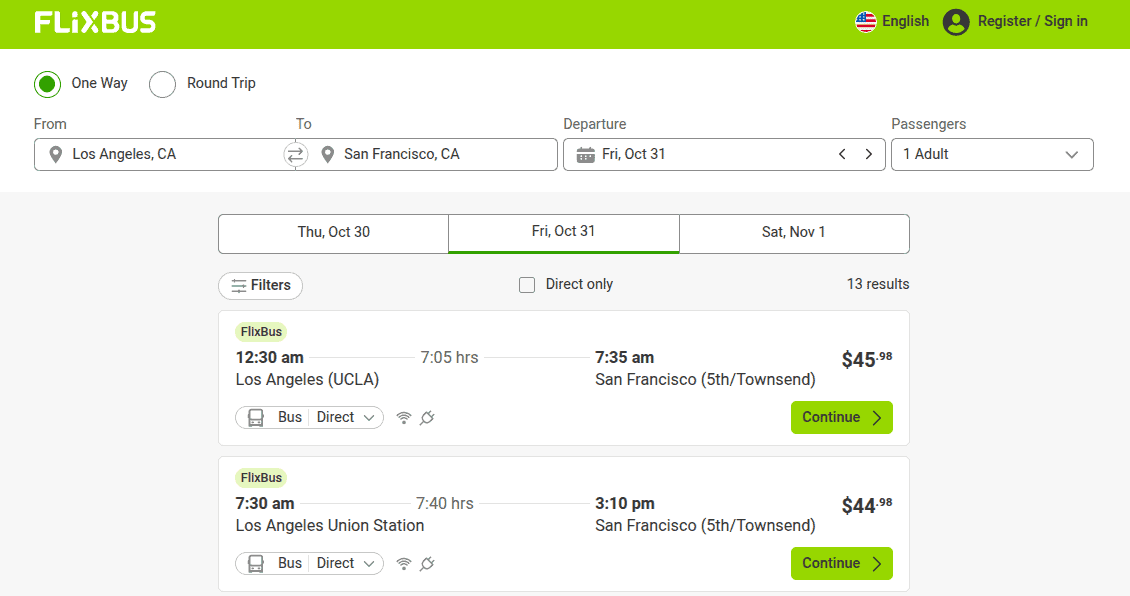
You could also choose to travel between Los Angeles and San Francisco by bus. One of the most affordable operators on this route is Flixbus, which offers tickets for as low as $45. The duration of this bus ride is about 7 or 8 hours.
Finally, another option for getting from Los Angeles to San Francisco is renting a car and driving there on your own. We found that the cost to rent a car for two days between these two cities would be about $150. However, you’d also have to pay for the gas to get you there.
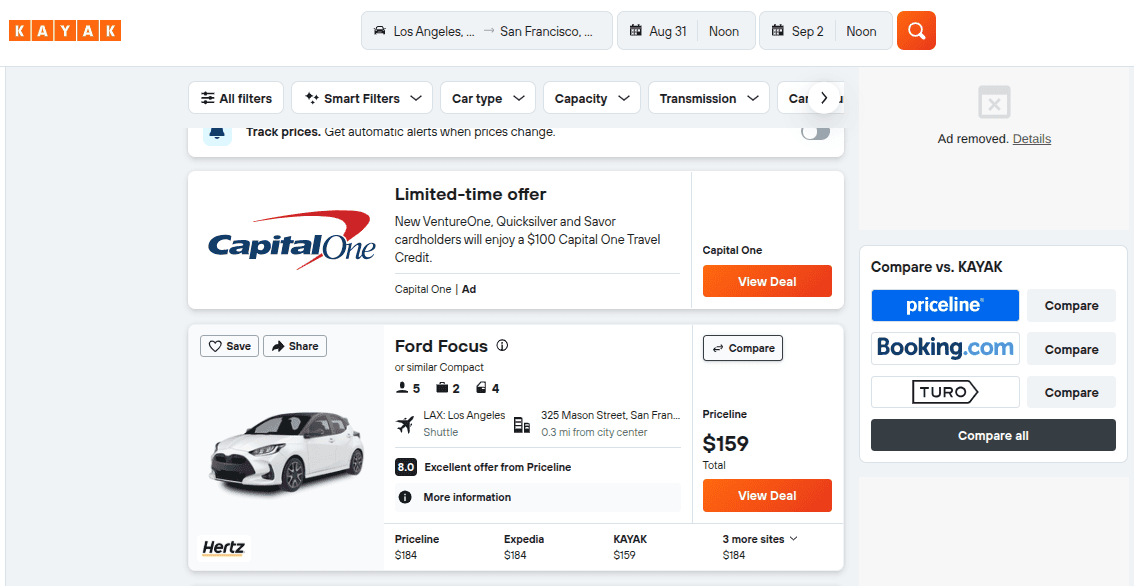
As you can see, there are several different options at several different price-points. If you’re looking for the most time-efficient option, then flying is the way to go considering the price is around the same as the other cheapest options and flying is considerably faster.
If you have a lot of time between your flight segments and you want to do some exploring, then renting a car is probably the best option. But you’ll need to be willing to spend a little more money.
Personally, I‘d probably choose to take the Amtrak train if I had the time to do so. I’m generally a fan of train travel, the price is pretty comparable to the other options, and the Coast Starlight is a highly regarded scenic train ride.
As you can see, the question of whether ground transportation is worth it and, if so, which type of ground transportation to go with is ultimately a question of personal preference, budget and time restriction.
Turn Your Next Trip Into an Epic Multi-City Adventure
Multi-city open-jaw flights can offer several distinct advantages when booking your next travel adventure. For one, they can save you money. If you need to book a multi-city itinerary, booking it as an open-jaw is cheaper through most airlines than booking separate one-way flights.
Booking open-jaw flights can also give you the freedom and flexibility to explore more places without having to backtrack in order to catch a return flight. Likewise, it can save you time if you have to return to a different city in your home country than the one you set out from.
By understanding open-jaw flights and how to book them, you can more effectively book future travel and have even more adventures at a lower cost.

New to the world of points and miles? The Chase Sapphire Preferred® Card is the best card to start with.
With a bonus of 75,000 bonus points after you spend $5,000 on purchases in the first 3 months from account opening. , 5x points on travel booked through the Chase TravelSM Portal and 3x points on restaurants, streaming services, and online groceries (excluding Target, Walmart, and wholesale clubs), this card truly cannot be beat for getting started!
Editors Note: Opinions expressed here are author’s alone, not those of any bank, credit card issuer, hotel, airline, or other entity. This content has not been reviewed, approved or otherwise endorsed by any of the entities included within the post.
10xTravel is part of an affiliate sales network and receives compensation for sending traffic to partner sites, such as CreditCards.com. This site may earn compensation when a customer clicks on a link, when an application is approved, or when an account is opened. This compensation may impact how and where links appear on this site. This site does not include all financial companies or all available financial offers. Terms apply to American Express benefits and offers. Enrollment may be required for select American Express benefits and offers. Visit americanexpress.com to learn more. All values of Membership Rewards are assigned based on the assumption, experience and opinions of the 10xTravel team and represent an estimate and not an actual value of points. Estimated value is not a fixed value and may not be the typical value enjoyed by card members.
Editors Note: Opinions expressed here are author’s alone, not those of any bank, credit card issuer, hotel, airline, or other entity. This content has not been reviewed, approved or otherwise endorsed by any of the entities included within the post.

bonus cash back
after you spend $6,000 on purchases in the first 3 months from account opening
to use on Capital One Travel
in your first cardholder year, plus earn 75,000 bonus miles once you spend $4,000 on purchases within the first 3 months from account opening - that’s equal to $1,000 in travel
bonus points
after you spend $5,000 on purchases in the first 3 months from account opening.

Membership Rewards® Points
after you spend $6,000 in eligible purchases on your new Card in your first 6 months of Card Membership. Welcome offers vary and you may not be eligible for an offer. Apply to know if you’re approved and find out your exact welcome offer amount – all with no credit score impact. If you’re approved and choose to accept the Card, your score may be impacted.