10xTravel is part of an affiliate sales network and receives compensation for sending traffic to partner sites, such as CreditCards.com. This site may earn compensation when a customer clicks on a link, when an application is approved, or when an account is opened. This compensation may impact how and where links appear on this site. This site does not include all financial companies or all available financial offers. Terms apply to American Express benefits and offers. Enrollment may be required for select American Express benefits and offers. Visit americanexpress.com to learn more. All values of Membership Rewards are assigned based on the assumption, experience and opinions of the 10xTravel team and represent an estimate and not an actual value of points. Estimated value is not a fixed value and may not be the typical value enjoyed by card members.
Note: Some of the offers mentioned below may have changed or may no longer be available. The content on this page is accurate as of the posting date; however, some of our partner offers may have expired. You can view current offers here.
Congratulations, you’ve booked a voyage to Antarctica with the 10xTravel team and are probably jumping for joy! I remember how I felt when I booked my first and only trip to the Great White South: excited, incredulous and perhaps the most memorable feeling—nervous.
To be fair, my sudden apprehension was justified. I simply didn’t know what to expect from such a big journey. I had dreamed about an Antarctica trip for so long that I had mixed emotions when it finally was becoming a reality.
I have to add that I booked my trip just a week before the sailing date to take advantage of last-minute pricing. Not to mention, I was already in Argentina, so I had zero time to prepare. However, you guys are lucky because you have a lot of time to figure out exactly what you need before traveling to Antarctica.
So, here’s what I’ve learned and what you can expect from your trip to Antarctica.
What to Pack for an Antarctica Trip
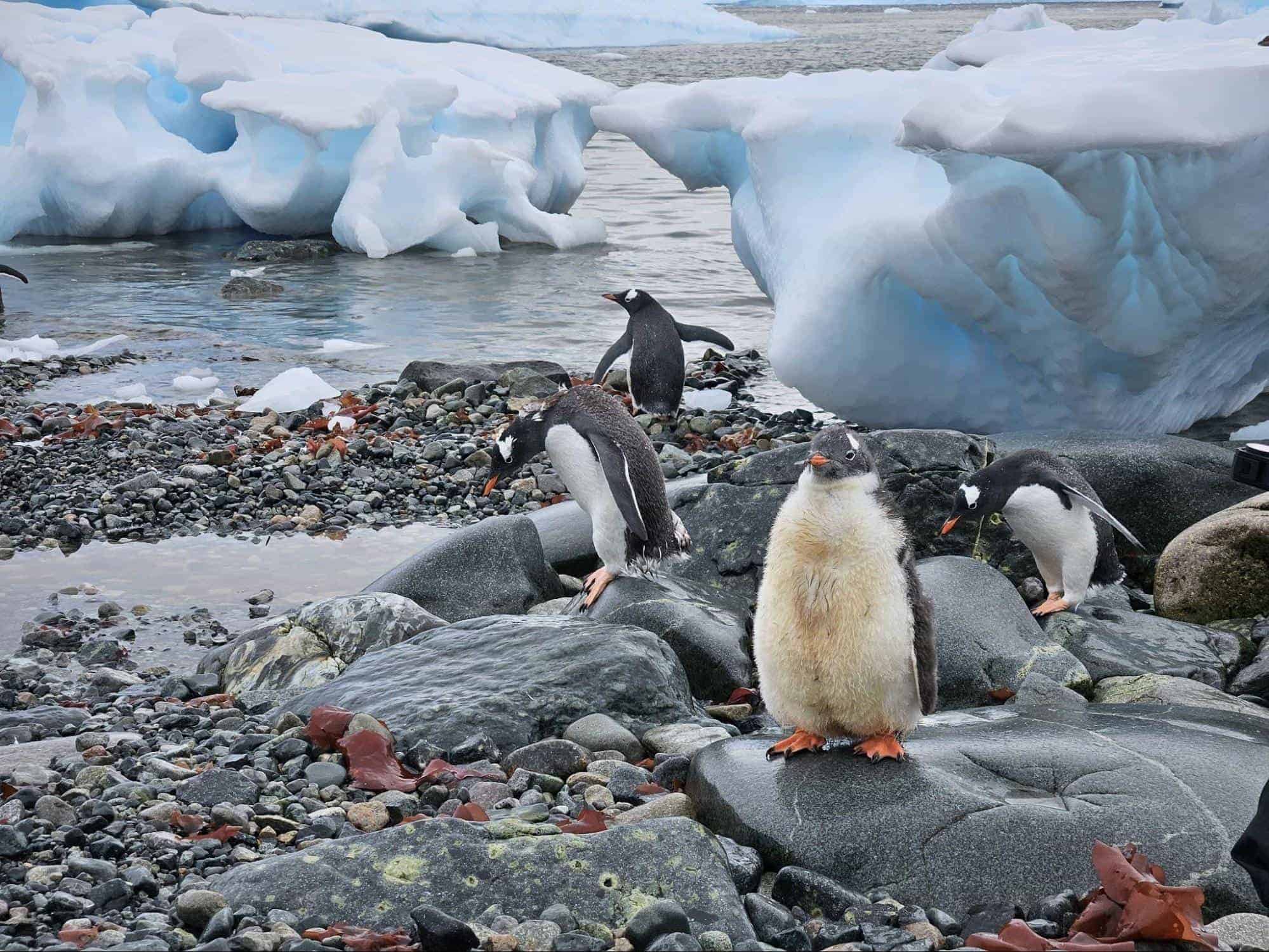
Penguins nest ashore in South Shetland Islands near Antarctica. | Photo by Anya Kartashova
Waterproof Pants
When packing for an Antarctica cruise, the most important item of clothing you’re going to want is a pair of waterproof pants. Whether you’re cruising in a Zodiac (a durable inflatable boat), making landings or kayaking among ice sheets, you’ll be in close proximity to water, meaning there’s a high chance you’ll get wet at some point.
You’ll be getting in and out of a Zodiac multiple times per day (weather permitting), and there’s no dock anywhere—you’re in the wilderness. Waterproof pants will be the only thing keeping your legs dry, so invest in a good pair.
Warm Clothes
One of the most surprising things for me personally was finding out that Antarctica isn’t that cold. During my trip in March 2024, the daily temperatures were in the range of 30 to 34 degrees Fahrenheit, and the water temperature was similar.
So, in addition to waterproof pants, it’s important to pack lots of thermal layers, preferably made of wool or fleece, the kind you can take off at any time if it gets a bit balmy.
Of course, bring wool socks, a hat, gloves and a scarf to cover your basics. You might spend quite a bit of time admiring the otherworldly nature of Antarctica from the ship when you’re not on land, and you want to stay warm.
Swimsuit
This might sound counterintuitive, but you absolutely must bring a swimsuit on your Antarctica trip. Many expedition ships include a pool, a hot tub and even a sauna aboard.
Additionally, your program will likely offer a polar plunge. You read that right—you’ll have a chance to swim in the Southern Ocean on your trip. How cold is that water? It’s actually not that bad, about 34 degrees Fahrenheit. The majority of travelers on my ship participated in the polar plunge the first time, and about half did it again a few days later. If you’ve ever wanted to feel like a penguin, this is your chance.
Camera with a Long Lens
If you’re not a professional photographer, don’t worry. Smartphone cameras offer such high-quality images these days that you won’t have any issues capturing the White Continent’s beauty.
However, if you have access to proper equipment, pack a long lens! In my case, I was already traveling in South America and I hadn’t packed any camera equipment, but knowing what I know now, I would have wanted to have a DSL camera with a zoom lens, at least 80 to 200 mm (300 mm if you have space in your carry-on bag).
Although you get to see many animals (including penguins, seals, whales), it is required to keep a distance of at least 16 feet (5 meters) from the wildlife on land and walk away if the animals approach you. So, you don’t really get close enough to capture a lot of detail with your smartphone camera. A long lens will allow you to take close-up photos without disturbing the animals.
Motion Sickness Medication
If you and the sea aren’t friends, that’s all right. You don’t have to be to enjoy life. However, there’s one big and scary obstacle between you and your Antarctic dream—the Drake Passage, a body of water that separates South America and the Antarctic Continent.
The Drake Passage comes in two variations: the Drake Lake and the Drake Shake. I believe I don’t have to explain either of these nicknames to you. Let me just say that you don’t want to be caught off guard without seasickness medication if you encounter the Drake Shake.
In my case, the options were quite limited. I wasn’t able to get my hands on any scopolamine transdermal patches (used to prevent nausea and vomiting) in Argentina, so my only option at a random Argentine pharmacy was a supply of Dramamine large enough to knock out a small horse. If you can get a scopolamine transdermal patch prescription in the United States (and you know that they work for you), that’s another option you can explore.
Now, I’m not qualified to give medical advice, but I do know that a rough day at sea can put a damper on anyone’s vacation, and the Drake Passage takes not one, but two days to cross. So, do with this as you will.
Sunscreen / Lotion / Sunglasses
You might find it hard to believe, but Antarctica is the windiest and the driest place on Earth, so it’s best to pack some moisturizing lotion, and while you’re at it, throw some sunscreen in your bag as well. The surface of the snow and ice reflect UV rays in a way that requires high-SPF protection on your face, and a thinning ozone layer makes the matter even worse. For these reasons, you’ll also benefit from a pair of sunglasses.
Things You Don’t Need to Pack
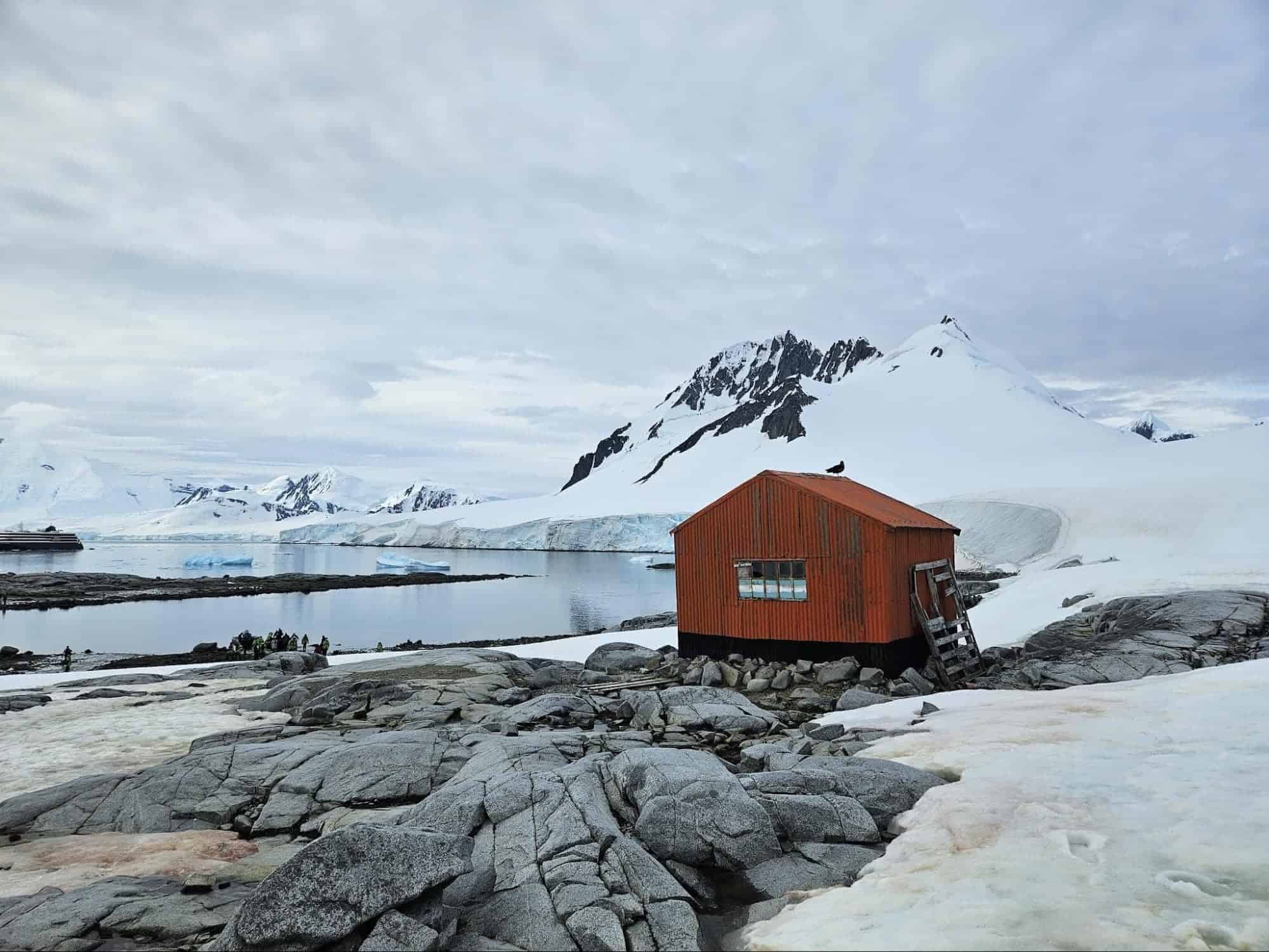
Waterproof boots, parka and binoculars are typically provided for your expedition to Antarctica. | Photo by Anya Kartashova
Waterproof Boots
The expedition ship you’ll be on will provide rubber boots for you, and they’ll be stored in the mud room. Upon each disembarkation, you’ll be required to put on these boots and a machine will scrub them clean with a brush before stepping off the ship. You’ll follow the same procedure every time you get back on to avoid any cross-contamination with the natural environment.
I recommend regular sneakers with a non-slip sole or hiking boots for going to breakfast and walking around the ship.
Winter Coat
Another item you don’t need to try to squeeze into your suitcase is a parka, at least not on the way to Antarctica. The expedition will likely include a jacket for you to use on each landing or Zodiac cruise, and it’ll be yours to keep as a memory of your trip to the continent.
Binoculars
A pair of binoculars is a nuisance to travel with, but luckily, they’re among the items you’ll find in your cabin. Unlike the parka, the binoculars won’t be yours to keep, but feel free to use them during your expedition to spot birds, leopard seals or even orcas if you’re lucky.
Cotton Clothes
Cotton might have its benefits, but isn’t a great material for cold weather. It is likely that you’ll be doing some physical activities, such as hiking or kayaking, during your stops, and cotton absorbs too much moisture to stay comfortable. Stick to wool, fleece or polyester for your apparel.
What Else to Expect from an Antarctica Expedition
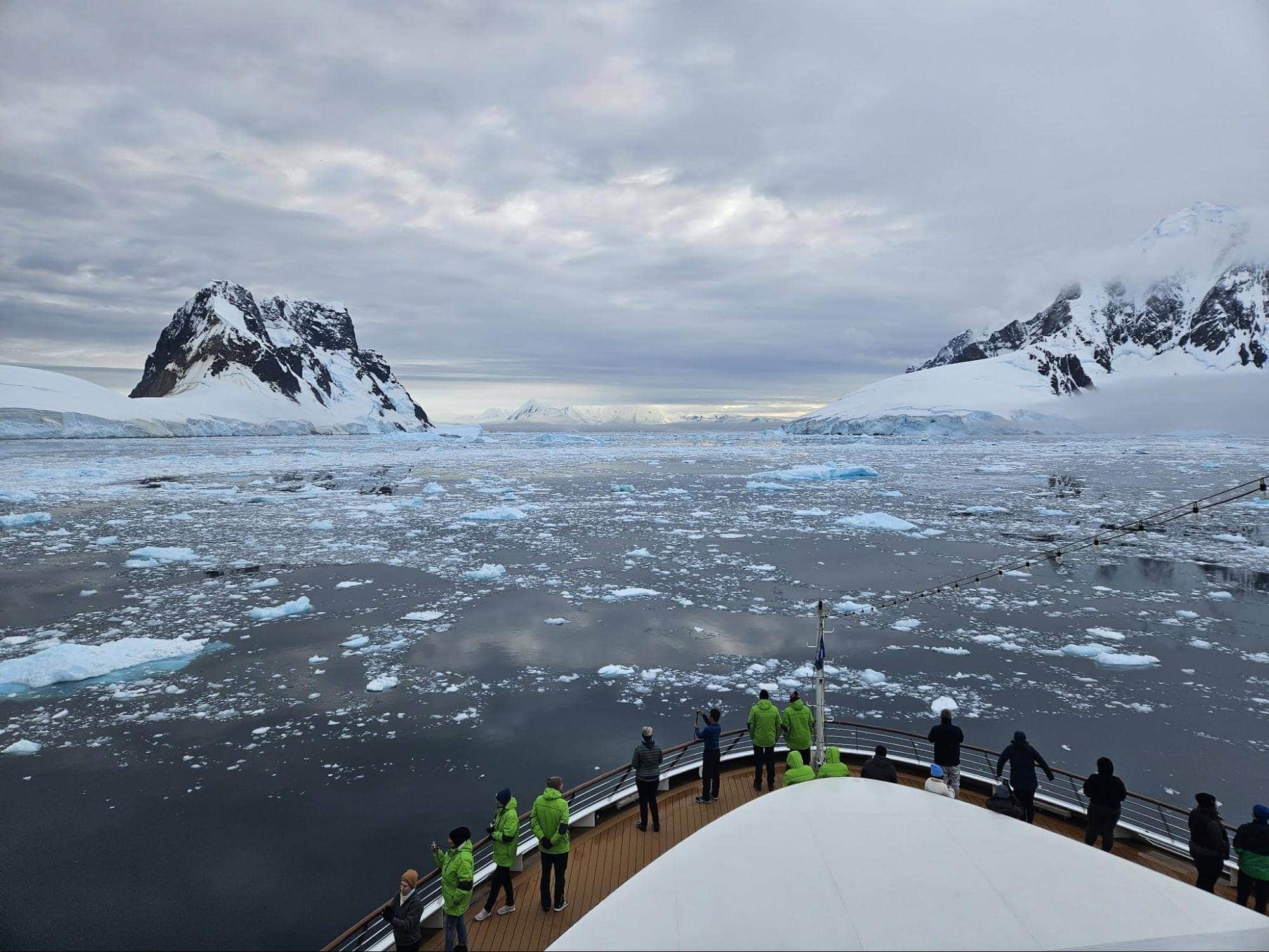
An expedition ship crosses the Lemaire Channel in Antarctica. | Photo by Anya Kartashova
Be Aware of Continent Landing Rules
Antarctica has a set of rules that all visitors must follow. For example, vessels with more than 500 passengers aren’t allowed to make landings. Additionally, no more than 100 individuals are allowed to land on the continent at the same time. What this means is that the passengers are typically divided into groups, and each group will take turns going ashore or taking a Zodiac ride. Your group will go first on some days and last on others.
On our ship of fewer than 200 passengers, we were divided into four groups, and everyone took turns doing all the activities. There was one close call, but overall, our expedition was successful, and we even crossed the Drake Passage earlier than expected, but it brings me to my next point.
Prepare for Any Weather
While visiting Antarctica, it’s important to set your expectations properly. Weather in Antarctica can be just as unpredictable as a ride closure at a theme park, and your landing might be cut short or not happen at all.
On my particular trip, my group was scheduled last to land on Deception Island. Unfortunately, by the time it was our turn, the wind picked up, and it was no longer safe to take a Zodiac across choppy waters. Our landing was cancelled.
It was supposed to be our first landing of the trip, so I was quite bummed when I heard we couldn’t do it. However, 30 minutes later, the wind calmed down, and we were back on! In the end, I got to participate in that first landing, but boy, was it an emotional rollercoaster.
All this is to say be prepared to not step foot on Antarctica during your sailing at all. Unfortunately, this kind of stuff can happen in a harsh environment, and safety is the most important thing on expeditions where the weather conditions can change in a blink of an eye.
Attend Lectures
During the two-day Drake Passage crossing, you’ll have lots of free time to roam the ship and enjoy its amenities. Additionally, your expedition team will provide lectures covering various topics in the auditorium. For example, there might be lectures on arctic birds, exploration of Antarctica and the aurora borealis/australis phenomenon, to name a few.
My advice is go to all the lectures (or at least view them on TV in your cabin if you’re feeling queasy) and ask as many questions as you can. When else will you have a chance to talk face to face to actual scientists and experts in the field from all over the world?
General Tips About Buenos Aires

Visit Casa Rosada, or the Pink House, while in Buenos Aires, the capital of Argentina, before or after your trip to Antarctica. | Photo by Anya Kartashova
Because Argentina will be your gateway to Antarctica, take note of a few useful tips about Buenos Aires, Argentina’s capital, and the country in general.
Should You Visit Argentina Before or After an Antarctica Cruise?
If you’re going to travel all that way, you might as well spend a few days in Buenos Aires before or after your Antarctica expedition. It’s such a vibrant city, full of tango dancers, delicious steakhouses and, of course, world-renowned wine.
I recommend staying in the neighborhoods of Palermo or Chacarita and enjoying the cafes, restaurants and shops in those neighborhoods.
For a mouthwatering, high-quality Argentine steak, head to La Cabrera for a happy hour from 6:30 p.m. to 8 p.m. and enjoy a 40% discount off the entire menu! Make sure to get on the list in person at 5 p.m., though, or you won’t get a table.
Should You Use Cash vs. Credit Cards in Argentina?
As you might have heard, Argentina’s economy is…unstable, to put it lightly. The country has multiple exchange rates for U.S. dollars to Argentine pesos—dollar blue being the most popular—and it can be difficult to navigate for a foreigner. Although the credit card conversion rate has gotten close to the dollar blue rate, it’s still not as high as what you’ll get for your cold hard cash.
In addition to the favorable exchange rate, some restaurants (not all, but some) offer cash discounts. You might see a 10% discount on cash transactions.
I recommend exchanging $100 bills at a money exchanger or a Western Union office and using cash to pay for all your purchases. I know it sounds wild to recommend using cash in a group full of points and miles enthusiasts, but you’ll get the best bang for your buck, quite literally, by exchanging U.S. dollars.
How Do You Get Around Buenos Aires?
If you plan on staying in Buenos Aires for a few days, you can use Uber. Yes, it’s going to be significantly more expensive than public transport, but it’s an easy option for a foreigner. For those with a sense of adventure, I recommend using a bus. You can get practically anywhere in Buenos Aires by bus, and it’s fast and inexpensive.
To ride the bus in Buenos Aires, you’ll need to purchase a SUBE card and load it with pesos beforehand. You can load it at many kioskos (convenience stores) and subway stations. The cost of a ride will depend on how far you’re going, and you’ll need to tell the driver the approximate intersection where you need him to stop. You can use a single SUBE card for multiple people by tapping it multiple times upon entering the bus.
Does Buenos Aires Have Multiple Airports?
Yes, Buenos Aires has two airports: Ezeiza International Airport (EZE) and Aeropaque Jorge Newberry (APQ). Ezeiza is likely going to be your point of entrance into Argentina because it operates many international flights. Aeroparque services more regional flights within Argentina and to other LatAm destinations.
Both airports offer flights to Ushuaia, which is your departure point for an Antarctica cruise, located on the Tierra del Fuego Archipelago in southern Patagonia.
If you’re going to stay in Palermo for a few nights before your flight to Ushuaia, I recommend flying out of Aeroparque. It’s not only closer to the city center, saving you money on an Uber ride, but it’s also a much calmer airport security- and crowd-wise.
Final Thoughts
Believe me when I say that Antarctica is a trip of a lifetime. You’ll never forget seeing the penguins clumsily walking on land or the whales frolicking in the water while circling your Zodiac. And the scenery! It’s just all so magical.
Of course, Argentina in general and Buenos Aires specifically deserve a trip on their own, but if you’ve got the time, you might as well add it to your itinerary. As they say, come for Antarctica and stay for the wine. (OK, I’m the only one who says that.)

New to the world of points and miles? The Capital One Venture Rewards Credit Card is the best card to start with.
Current offer: Limited Time Offer: Enjoy a $300 stays credit, plus earn 75K bonus miles once you spend $4,000 on purchases within 3 months from account opening.
Earn 5X miles on hotels, vacation rentals and rental cars booked through Capital One Travel; 2X miles on all purchases.
Editors Note: Opinions expressed here are author’s alone, not those of any bank, credit card issuer, hotel, airline, or other entity. This content has not been reviewed, approved or otherwise endorsed by any of the entities included within the post.
10xTravel is part of an affiliate sales network and receives compensation for sending traffic to partner sites, such as CreditCards.com. This site may earn compensation when a customer clicks on a link, when an application is approved, or when an account is opened. This compensation may impact how and where links appear on this site. This site does not include all financial companies or all available financial offers. Terms apply to American Express benefits and offers. Enrollment may be required for select American Express benefits and offers. Visit americanexpress.com to learn more. All values of Membership Rewards are assigned based on the assumption, experience and opinions of the 10xTravel team and represent an estimate and not an actual value of points. Estimated value is not a fixed value and may not be the typical value enjoyed by card members.
Editors Note: Opinions expressed here are author’s alone, not those of any bank, credit card issuer, hotel, airline, or other entity. This content has not been reviewed, approved or otherwise endorsed by any of the entities included within the post.

bonus cash back
after you spend $6,000 on purchases in the first 3 months from account opening.
earn 75K bonus miles
once you spend $4,000 on purchases within 3 months from account opening.

bonus points
after you spend $5,000 on purchases in the first 3 months from account opening.
Membership Rewards® Points
after you spend $8,000 in eligible purchases on your new Card in your first 6 months of Card Membership. Welcome offers vary and you may not be eligible for an offer. Apply to know if you’re approved and find out your exact welcome offer amount – all with no credit score impact. If you’re approved and choose to accept the Card, your score may be impacted.