
10xTravel is part of an affiliate sales network and receives compensation for sending traffic to partner sites, such as CreditCards.com. This site may earn compensation when a customer clicks on a link, when an application is approved, or when an account is opened. This compensation may impact how and where links appear on this site. This site does not include all financial companies or all available financial offers. Terms apply to American Express benefits and offers. Enrollment may be required for select American Express benefits and offers. Visit americanexpress.com to learn more. All values of Membership Rewards are assigned based on the assumption, experience and opinions of the 10xTravel team and represent an estimate and not an actual value of points. Estimated value is not a fixed value and may not be the typical value enjoyed by card members.
Note: Some of the offers mentioned below may have changed or may no longer be available. The content on this page is accurate as of the posting date; however, some of our partner offers may have expired. You can view current offers here.
Launched in late summer 2025, the Atmos™ Rewards Summit Visa Infinite® credit card made waves with its valuable perks, such as the annual 25,000-point Global Companion Award and 3X earning on foreign transactions.
However, the most unique and eye-catching perk may be the 100,000-point Global Companion Award that you can earn after spending $60,000 on the card in a card anniversary year.
Through Alaska Airlines’ and Hawaiian Airlines’ extensive partner network, this 100K companion certificate can potentially get you a free round-trip business-class fare to prime travel destinations all over the world.
But let’s be real–$60,000 is a lot to put on any card in a year. Going for it requires commitment and a lot of planning if it’s even worth going for in the first place.
Let’s break down everything about the 100,000-point certificate, potential redemption options and factors to consider before pursuing. Then, if you decide to embark on this journey, we’ll share a roadmap for achieving the $60,000 spend as seamlessly as possible.
Atmos Rewards Summit Card 100K Global Companion Certificate
Let’s start off with some basics. The 100K Global Companion Certificate allows you to deduct up to 100,000 Atmos points on an award booking for two people. According to Alaska’s FAQs, the certificate holder doesn’t have to be one of the travelers, so you can use the certificate for two family members or friends.
To earn the certificate, you must spend $60,000 on your Atmos Rewards Summit card within your cardmember anniversary. For example, if you were approved for the card on Sept. 1, 2025, you have until Sept. 1, 2026, to spend $60,000.
After you reach this spend, expect the 100K certificate to show up in your account in four to six weeks. The certificate expires 12 months after issuance. Travel can occur 12 months after issuance, as long as you book before the expiration date.
A nice perk of this certificate is that you can top it off with points. For example, a round-trip business-class redemption on Japan Airlines from Seattle (SEA) to Tokyo (NRT) requires 120,000 Atmos Rewards points per person. You can redeem the certificate to deduct 100,000 points from the second ticket and use 20,000 points to make up the difference. Then, two seats would run you only 140,000 points when it would normally cost 240,000.
Importantly, if the companion ticket costs fewer than 100,000 points, the unused portion of the Global Companion Award is forfeited. For example, a round-trip economy-class redemption on Hawaiian Airlines from Seattle (SEA) to Tokyo (NRT) costs 60,000 points per person. The certificate can deduct up to 100,000 points off a companion, so you’d be forfeiting 40,000 points of value here. In total, two seats would cost 60,000 points.
We’ll look at some more redemption examples later in the article. For now, just realize that the value you get from the certificate plays a significant part in whether or not you should pursue it in the first place.

Overview of Rewards for Spending $60,000
If you were to spend $60,000 on your Atmos Summit card, the 100K certificate isn’t the only perk you’d earn. There are a few other benefits you’ll pick up along the way, and these should all be factored into your calculations.
Let’s zoom into the Atmos Rewards program to cover everything you’ll earn on the road to spending $60,000. For each earned reward, we’ll also do our best to assign a low, high and average value. Our goal is to come up with some estimates to determine how much value we can expect to get, which will help us make a better decision on whether to commit to the $60,000 spend.
Note that we won’t be factoring in the welcome offer in this article. This will help us accurately see what it looks like to pursue the $60,000 spend in year two and beyond. For first-year cardmembers, the welcome offer obviously adds a ton of extra value.
Atmos Rewards Redeemable Points
With a $60,000 spend, you’re going to earn between 60,000 and 180,000 Atmos Rewards points, depending on how much you can utilize the 3X categories. Some lucky folks abroad may be able to take full advantage of the 3X on foreign transactions category and earn the full 180,000 points. Realistically, those living in the United States will probably end up with around 100,000 points on average.
As for the value of each redeemable point, we’ll use a conservative value of 1 cent per point (cpp). However, particularly with business-class redemptions, it’s possible to get outsized value of around 4 cents per point here. An average redemption might come out to 1.5 cpp.
- Points earned: 60,000 to 180,000
- Low-end value: $600 to $1,800 (60,000 to 180,000 points at 1 cpp)
- Average value: $1,500 (100,000 points at 1.5 cpp)
- High-end value: $2,400 to $7,200 (60,000 to 180,000 points at 4 cpp)
Atmos Rewards Status Points
Every $2 that you spend on the Atmos Summit card translates into one status point in the Atmos Rewards program. This means that you’ll get 30,000 status points after spending $60,000.
This is enough to earn you Atmos Silver/Oneworld Ruby status, which offers some baseline benefits when traveling on Alaska and its Oneworld partners. These include premium-class and first-class upgrades when available, but you’ll likely lose out to folks with higher status.
Unfortunately, 30,000 status points isn’t quite enough to get you to Atmos Gold. This is a particularly good status to get because it translates into Oneworld Sapphire, which grants you worldwide business-class lounge access whenever you’re traveling with a Oneworld partner.
Note that the annual 10,000 anniversary status points benefit on the Atmos Summit card kicks into effect only starting on your first cardmember anniversary, so you don’t get this boost in year one. However, in future years, you’d be able to use this boost to achieve Atmos Gold with $60,000 in spend.
At the low end, you might get little value from Atmos Silver status, especially if you never get upgraded and don’t need the free checked bag benefits. At the high end, if you travel on Alaska and Hawaiian often and frequently make use of free checked bags, Atmos Silver is super valuable for you. Most people will probably find themselves somewhere in the middle.
- Status earned: Atmos Silver
- Low-end value: $0 (no upgrades, no free checked bags or no flights on Alaska/Oneworld)
- Average value: $380 ($45 waived checked baggage fee, four flights per year, upgraded to premium/first class two flights per year at $100 per upgrade)
- High-end value: $1,900 ($35 waived checked baggage fee, 20 flights per year, upgraded to premium/first class, 10 flights per year at $100 per upgrade)
Atmos Rewards Milestones
In addition to all these points, the Atmos Rewards program also contains milestone bonuses as you reach certain status thresholds within a calendar year.
Upon reaching 10,000 status points, you’ll get to select from a few benefits. For the purposes of this article, we’ll assume that you pick the 750 bonus points option because the others are pretty difficult to value and are highly dependent on personal circumstances. On its own, 750 bonus points is not a gamechanger by any means, but it’s better than nothing.
- Typical value range: $7.50 to $30 (1 cpp to 4 cpp)
- Average value: $11.25 (1.5 cpp)
Upon reaching 20,000 status points, you’ll reach Atmos Silver status. We already valued this in the previous section. However, we didn’t mention that Atmos Silver also grants you 25% bonus points on flights with Alaska and its partners. This means that if you are a frequent flyer of Alaska and Oneworld airlines, you could rack up a lot more redeemable points, making Atmos Silver even more valuable than our previous numbers suggest.
Upon reaching 30,000 status points, you again have a few benefits to choose from, but we’ll assume that you pick the 2,500 bonus points option.
- Typical value range: $25 to $100 (1 cpp to 4 cpp)
- Average value: $37.50 (1.5 cpp)
Upon reaching 40,000 status points, you’ll earn Atmos Gold status. This also grants you a 50% bonus on redeemable points when flying with Alaska and its partners. Fifty percent is a decent bonus, so depending on how often you fly Oneworld, achieving Atmos Gold can be even more valuable than previously mentioned.
100K Global Companion Certificate
Finally, the star of the show: the 100K Global Companion Certificate itself. On the surface, this may seem like an easy benefit to value—just assume that it’s worth 100,000 points, right?
For a quick and dirty estimate, yes. Based on our cent-per-point estimates so far, we can roughly value this at $1,000 at 1 cpp to $4,000 at 4 cpp (we’ll see how these estimates stack up against actual redemption options in the next section).
The nuance here is that you may end up not using the entirety of the 100K certificate. For instance, if you manage to find a redemption valued at just 75,000 points, you’d forfeit the remaining 25,000 points.
To be more conservative and realistic with our estimates, we’ll assume that you take this “discount” more often than not. So, let’s say that the actual value you get from this certificate to be between 60,000 and 100,000 points:
- Low-end value: $600 to $1,000 (60,000 to 100,000 points at 1 cpp)
- Average value: $1,200 (80,000 points at 1.5 cpp)
- High-end value: $2,400 to $4,000 (60,000 to 100,000 points at 4 cpp)
100K Certificate Redemption Options
Before we go and crunch some more numbers, let’s first highlight some of the awesome redemptions you could make with the 100K certificate. Time to grab your player two and get inspired.
Starlux Airlines Business Class
Starlux Airlines business class is one of my favorite redemptions to date. The latest Taiwanese carrier delivers a truly luxurious experience across the Pacific.
Generally, business-class availability between the U.S. and Asia is difficult to come by. For this redemption, you’ll typically find only the lowest rate seats (75,000 Atmos points per direction) within seven days of your departure date.
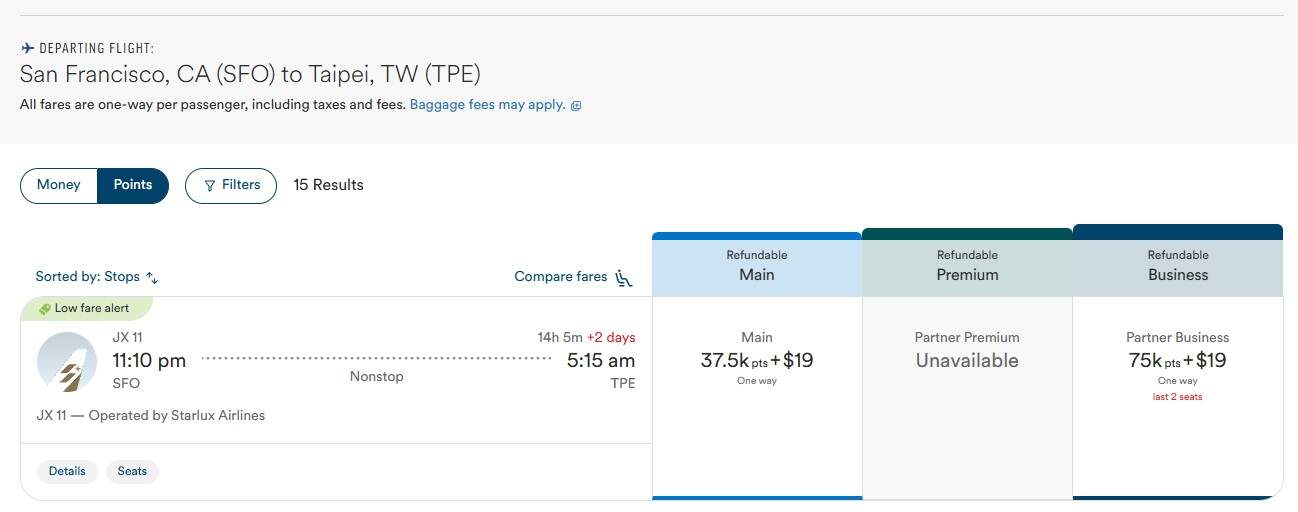
So for 75,000 points and a bit of extra cash, you could fly two people to Taipei, Taiwan (TPE), in style. Yes, you are giving up 25,000 points in value here, but that’s hardly a loss given what you’re getting. Cash rates for this route typically start at around $3,500.
Condor Airlines Business Class
For your next journey to Frankfurt, Germany (FRA), Condor Airlines can get you there in business class for just 55,000 Atmos points one way from the East Coast. Availability generally tends to be a bit easier to find than on the Asia routes.
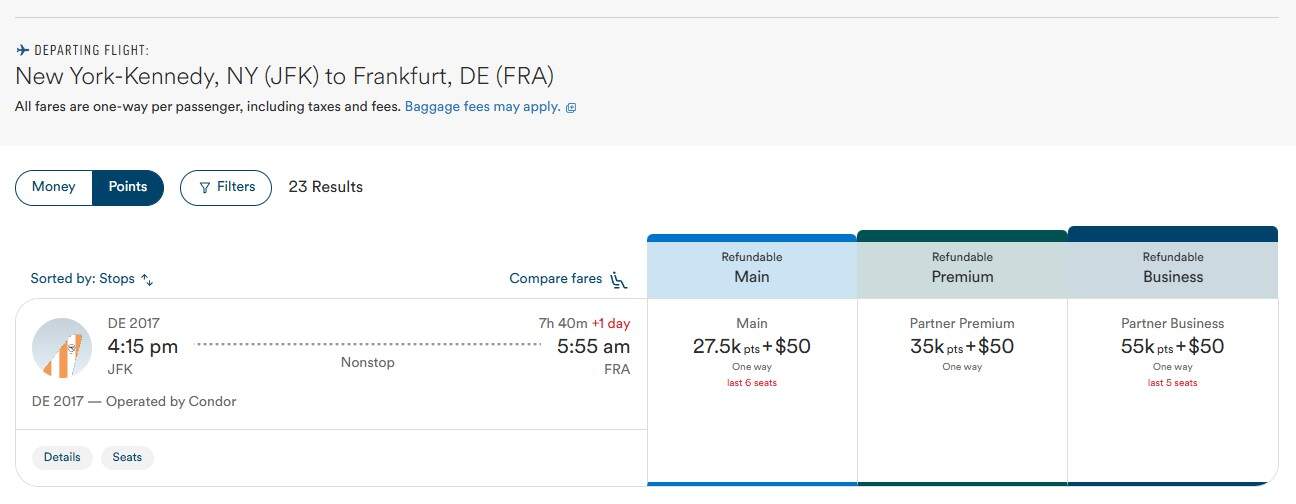
This is a great deal. It also means that if you can find a return leg as well, the total cost would be 110,000 points per person. You’d need to top off with just 10,000 more points for your player two to make this round-trip reservation, bringing the total points cost to 120,000.
Cash rates for this route typically start at $1,450 during non-peak travel times and go upwards of $3,000 on peak dates.
American Airlines Business Class
For a round-trip business class option that fits perfectly within the 100,000-point limit, try American Airlines to Sao Paulo (GRU). It’s just 50,000 points each way with decent award availability.
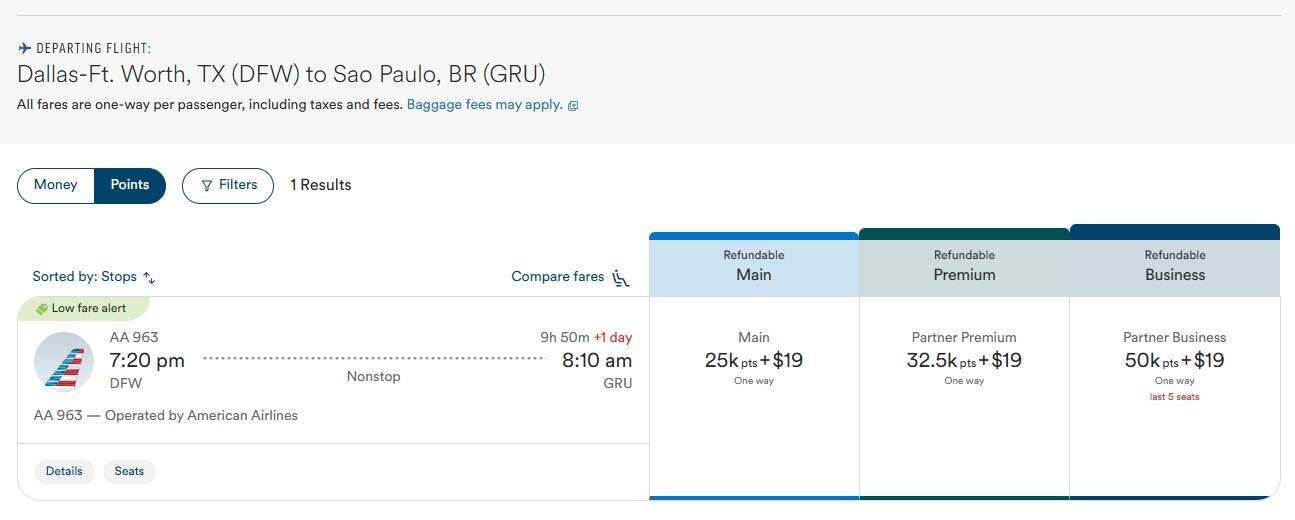
At 100,000 points round trip, this is a perfect use for the certificate and a great chance to explore Brazil. Cash rates for round-trip business-class flights typically start at $5,000.
Hawaiian Airlines Business Class
Following the Alaska-Hawaiian merger, Hawaiian Airlines is opening more long-haul routes to destinations in Asia and Europe. One example is the relatively new route from Seattle (SEA) to Tokyo (NRT), currently at 95,000 points one way.
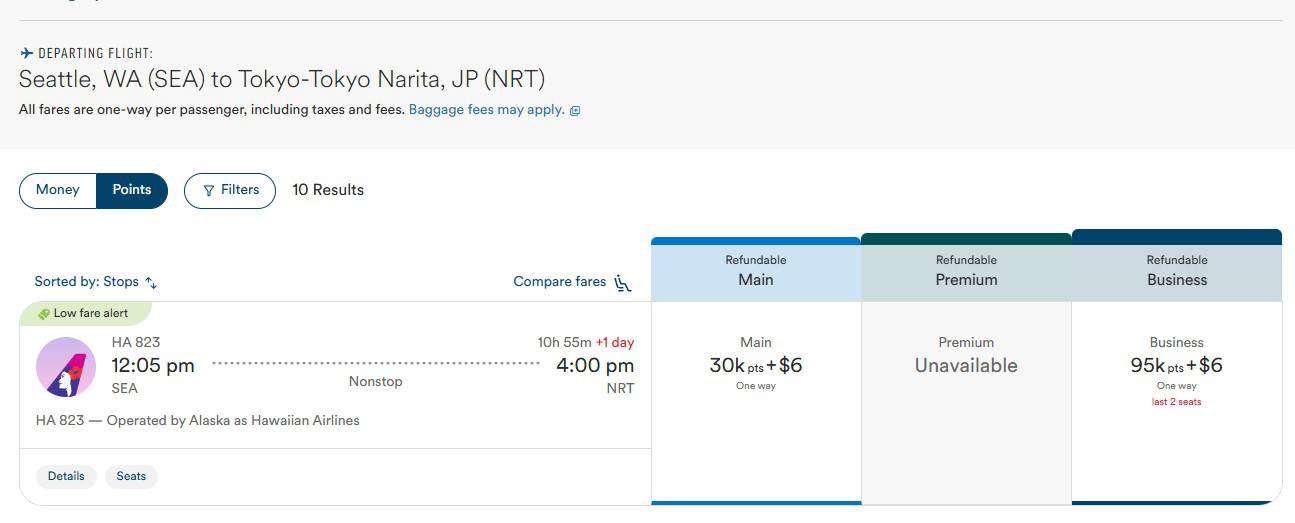
This is a steep price to pay, but Japan is still a bucket-list for many, and flying there in business class is a luxury. Cash rates for this route typically start at $3,200 during non-peak travel times.
Round-trip Premium Economy
So far, we’ve focused on business-class cabins. However, another perfectly viable option is to opt for premium economy, which is often much easier to find when redeeming points and miles. Also, because of the lower rates, you’re more than likely to turn this into a round-trip ticket with the 100K certificate.
As an example, the one-way redemption rate in premium economy on Japan Airlines from Chicago (ORD) to Tokyo (HND) is 50,000 Atmos Rewards points.
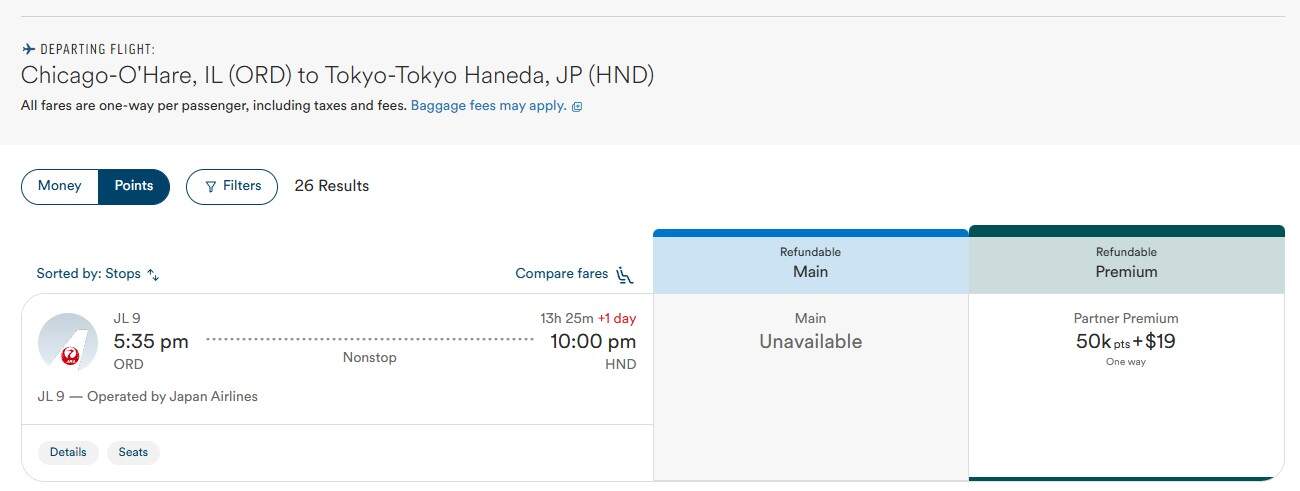
With plenty of award space, a round-trip itinerary will cost you 100,000 points. Cash-wise, this route also starts at around $3,300 round trip, so this is another perfectly good use of the certificate.

Summary: Return on Spend for $60,000
Having seen some example redemptions, we can now give a final estimate for the total return on spend you’d get for spending $60,000 on the Atmos Summit card.
For this exercise, note that most of the example redemptions would result in more than $3,000 in value for the 100K certificate. However, the best redemptions are never guaranteed, so we’ll still use the appropriate low-end, high-end and average values from the overview section in this table:
| Reward | Low-end value | High-end value | Average value |
|---|---|---|---|
| 60,000 to 180,000 Atmos Points | $600 | $7,200 | $1,500 |
| Atmos Silver Status | $0 | $1,900 | $380 |
| Atmos 10K Milestone | $7.50 | $30 | $11.25 |
| Atmos 30K Milestone | $25 | $100 | $37.50 |
| 100K Companion Certificate Value | $600 | $4,000 | $1,200 |
| Total return | $1,232.50 | $13,230 | $3,128.75 |
Our estimates are now complete. For $60,000 in spend, you’ll get between $1,232.50 and $13,230.00 in value, with an average value of $3,128.75.
Let’s subtract the card’s annual fee to get a net return of $2,733.75. This average value gives us a return on spend of about 4.56%, which means it theoretically outperforms most “catch-all” credit cards, such as the Capital One Venture X Rewards Credit Card or the Chase Freedom Unlimited®.
Remember, these numbers don’t even take into account the welcome offer, which only sweetens the deal in year one.
This makes it an excellent option to consider basing your credit card spending strategy on. However, there are still a couple larger questions to answer: How can you best achieve this spend? And what “gotchas” do you need to consider before dedicating $60,000 of spend on the card?

Capital One Venture X Rewards Credit Card
Earn 75,000
Bonus Miles
when you spend $4,000 on purchases in the first 3 months from account opening, equal to $750 in travel
Annual Fee: $395

Earn a $200
Bonus
after you spend $500 on purchases in your first 3 months from account opening
How to Hit $60,000 Spend
Here’s an obvious fact—spending $60,000 on a single card in one year is a lot. Many individuals and households don’t naturally accrue that type of spend, so you’ll need to go about this strategically.
For starters, look at the big picture and map out where this spend will come from. In particular, we think your largest two buckets will be the following: rent and foreign transactions.
Rent Payments
A special partnership with Bilt allows Atmos Summit cardholders to use their card to earn 3X Atmos points on rent, up to $50,000 per calendar year.
The catch? You’ll incur a 3% fee, which can add up if your rent is expensive. You’ll have to weigh this against the potential gains you’ll get from all the rewards we discussed earlier.
However, in my opinion, rent is a crucial piece of the $60,000 puzzle. To achieve that level of spend, you’ll probably need to accept this fee. The good news is that at least you’ll be earning 3X points, which can help you rack up Atmos points quickly.
Personally, I’ll be biting the bullet and eating the 3% fee on my rent since I’m confident in being able to extract more value out of the points and eventual 100K certificate.
Obviously, if you don’t rent, you’ve lost an easy way to organically spend $60,000. This can also apply if your rent payment is too small to make a noticeable dent in the $60,000 (i.e. below $1,500 per month or so, which is $18,000 annually).
Travel / Foreign Transactions
Another superpower of this card is the fact that it earns 3X on all foreign transactions. If you live abroad or are a frequent traveler, make sure the Atmos Summit card is the first card in your wallet.
$60,000 Budget Plan
From these two major categories, you can figure out if $60,000 is an attainable figure for you. For example, suppose that your rent is $3,000 per month (after the 3% fee), and you have two large trips in the next year where you expect to spend $4,000 abroad each trip.
- Rent: $3,000 per month for 12 months is $36,000
- Foreign transactions: $4,000 per trip for two trips totaling $8,000
- Total: $44,000 out of $60,000 accounted for
This means that you’ll have to find $16,000 worth of everyday spend across 12 months. That’s around $1,334 per month, which is definitely doable.
If you find that your rent and foreign transactions are too low, we recommend against pursuing the certificate. You’ll probably be overspending in categories that earn just 1X, and you’ll be better off pursuing other welcome bonuses instead.

Special Considerations
Finally, before you run off and spend $60,000 on a single credit card, we recommend reading this section and being aware of any final considerations and gotchas.
Award Availability and Redemption Difficulty
The 100K certificate is not going to be an easy one to use. Maximizing this reward requires careful planning and backup plans in case there’s no award availability. We gave plenty of examples in this article, but you should research your own desired routes and come up with backups. Remember that there’s always a risk that the Atmos Rewards program suddenly raises the rates of redemptions or changes the landscape altogether.
There’s also the simple truth that finding award space for two is much harder than finding award space for one.
If you’re relatively new to the points and miles game, this 100K certificate probably isn’t something you should pursue. Instead, find some other cards that you might benefit from and get their welcome bonuses. You can always revisit the 100K certificate later.
If you’re already fluent with Alaska and Oneworld redemptions and don’t mind doing some extra homework to maximize this certificate, then go for it.
Opportunity Cost and Chase 5/24
One of the biggest arguments against pursuing the certificate is that your $60,000 is better spent getting other welcome bonuses. This is true because welcome bonuses usually always offer the highest return on spend. If there are other cards that you want to get in the next year, it’s more than reasonable to go for those instead of the 100K certificate.
That being said, if you want to spend a year laying low, going for this certificate is a great way to do that. For instance, you might be waiting for some cards to drop off your Chase 5/24 count. This is a great way to still rack up a ton of rewards while doing that.
Oneworld Status
As we saw earlier, you’ll rack up a bunch of Atmos status points while pursuing the 100K certificate. In year one, you’ll probably end up somewhere between Atmos Silver (20,000 status points) and Atmos Gold (40,000 status points) when all is said and done.
Atmos Gold is a pretty significant milestone because it grants business-class lounge access when traveling on Oneworld airlines internationally. This means that if you have any air travel, try to fly Oneworld and credit your flights to your Atmos Rewards account. Since you’re already getting a lot of status points via spend, you might as well go for Atmos Gold.
In year two, because of the 10,000-point status head start, 60,000 points of spend itself will get you to Atmos Gold. In that case, you might consider going for Atmos Platinum at 80,000 status points.
In Conclusion
So, is the Atmos Rewards 100K Global Companion Certificate worth pursuing? On paper, the math is compelling. You’re getting around 4.5% return on $60,000 in spend, which is especially great considering the potential for aspirational business-class redemptions for two travelers.
At the same time, extracting value from this certificate demands careful planning and a willingness to navigate the complex world of award availability. If you’re comfortable operating in the Alaska and Oneworld ecosystem and can organically hit the $60,000 spend, this is a great credit card strategy worth pursuing. Otherwise, your time and spend might be better allocated toward other welcome bonuses that also offer strong returns.

New to the world of points and miles? The Capital One Venture Rewards Credit Card is the best card to start with.
Current offer: Limited Time Offer: Enjoy a $300 stays credit, plus earn 75K bonus miles once you spend $4,000 on purchases within 3 months from account opening.
Earn 5X miles on hotels, vacation rentals and rental cars booked through Capital One Travel; 2X miles on all purchases.
when you spend $4,000 on purchases in the first 3 months from account opening, equal to $750 in travel
Annual Fee: $395
after you spend $500 on purchases in your first 3 months from account opening
Editors Note: Opinions expressed here are author’s alone, not those of any bank, credit card issuer, hotel, airline, or other entity. This content has not been reviewed, approved or otherwise endorsed by any of the entities included within the post.
10xTravel is part of an affiliate sales network and receives compensation for sending traffic to partner sites, such as CreditCards.com. This site may earn compensation when a customer clicks on a link, when an application is approved, or when an account is opened. This compensation may impact how and where links appear on this site. This site does not include all financial companies or all available financial offers. Terms apply to American Express benefits and offers. Enrollment may be required for select American Express benefits and offers. Visit americanexpress.com to learn more. All values of Membership Rewards are assigned based on the assumption, experience and opinions of the 10xTravel team and represent an estimate and not an actual value of points. Estimated value is not a fixed value and may not be the typical value enjoyed by card members.
Editors Note: Opinions expressed here are author’s alone, not those of any bank, credit card issuer, hotel, airline, or other entity. This content has not been reviewed, approved or otherwise endorsed by any of the entities included within the post.
bonus cash back
after you spend $6,000 on purchases in the first 3 months from account opening.
earn 75K bonus miles
once you spend $4,000 on purchases within 3 months from account opening.
bonus points
after you spend $5,000 on purchases in the first 3 months from account opening.

Membership Rewards® Points
after you spend $8,000 in eligible purchases on your new Card in your first 6 months of Card Membership. Welcome offers vary and you may not be eligible for an offer. Apply to know if you’re approved and find out your exact welcome offer amount – all with no credit score impact. If you’re approved and choose to accept the Card, your score may be impacted.