10xTravel is part of an affiliate sales network and receives compensation for sending traffic to partner sites, such as CreditCards.com. This site may earn compensation when a customer clicks on a link, when an application is approved, or when an account is opened. This compensation may impact how and where links appear on this site. This site does not include all financial companies or all available financial offers. Terms apply to American Express benefits and offers. Enrollment may be required for select American Express benefits and offers. Visit americanexpress.com to learn more. All values of Membership Rewards are assigned based on the assumption, experience and opinions of the 10xTravel team and represent an estimate and not an actual value of points. Estimated value is not a fixed value and may not be the typical value enjoyed by card members.
Note: Some of the offers mentioned below may have changed or may no longer be available. The content on this page is accurate as of the posting date; however, some of our partner offers may have expired. You can view current offers here.
India is one of the most diverse countries in the world, with 28 states and eight union territories, each offering a unique experience.
Whether you’re hiking in the mountains of Jammu and Kashmir, eating momos alongside Tibetan monks in the forests of Himachal Pradesh, taking a city trip to New Delhi, going East to the Himalayan hill stations of Uttarakhand or lazing on the beaches of South Goa, one trip is hardly enough to take full advantage of everything India has to offer. It’s no wonder that India features high on the bucket lists of many travelers.
However, getting from the United States to India isn’t easy or cheap.
Air India, United Airlines and American Airlines are the only carriers with whom you can fly nonstop to India from the United States. Since they operate these routes from a limited number of cities, it’s often more convenient to fly with different airlines closer to your home base, unless you’re willing to take a positioning flight. And while you may have to include a stop on your way to India, some frequent flyer award fares enable you to do so for free or for very few extra miles.
In this guide, we break down the best ways to fly to India using points and miles, from economy to first class. That way, you’ll have more cash to spend once you’re there.
Air Canada Aeroplan
Air Canada Aeroplan is a solid loyalty program when it comes to booking Star Alliance flights to India.
You can take advantage of Aeroplan’s zone- and distance-based partner award chart to score yourself and the family cost-effective award fares to India.
The U.S. falls into Air Canada’s “North America” zone, while India falls into the “Atlantic” zone. And a flight from the U.S. to India falls within Air Canada’s 6,001-8,000 miles distance category, resulting in the following award rates:
| Class | Number of Miles Required (One-Way) |
|---|---|
| Economy | 60,000 |
| Business | 90,000 |
| First | 130,000 |
You can take advantage of these lucrative award rates to fly with Star Alliance partners such as All Nippon Airways (ANA), Air India, Turkish Airlines, United Airlines as well as non-alliance partners like Etihad Airways and Emirates.
Aeroplan also allows you to add a stopover to your itinerary for an extra 5,000 miles, enabling you to explore an additional country on your way to (or from) India.
Just keep in mind that Aeroplan charges a partner booking fee of $39 Canadian dollars ($27 USD) per ticket. On the flip side, you won’t have to worry about paying fuel surcharges, so do the math to see if it’s a worthwhile use of your miles.
How To Earn Aeroplan Miles
Earning Aeroplan miles is easy.
American Express Membership Rewards points, Bilt Points, Capital One miles and Chase Ultimate Rewards points all transfer to Aeroplan miles at a 1:1 ratio.
You can also transfer Marriott Bonvoy points at a 3:1 ratio, with a points boost of 5,000 miles for every 60,000 points transferred.
If you fly frequently with Air Canada, you might consider opening the Chase Air Canada Aeroplan® Credit Card., enabling you to earn Aeroplan miles on everyday spending as well as benefit from status perks.

Air France-KLM Flying Blue
Air France-KLM Flying Blue offers competitive award rates for booking SkyTeam alliance flights to India.
While award rates are priced dynamically and there’s no published partner award chart, you can expect economy fares to start at around 35,000 miles one-way, business-class fares to start at 65,000 miles and first-class fares to start at 95,000 miles.
One of the key benefits of flying to India with Air France or KLM instead of a partner airline is the number of U.S. cities they operate flights out of. You can fly to Mumbai, New Delhi, Bangalore and Hyderabad from numerous U.S. cities—with a stopover in either Paris or Amsterdam—including Atlanta, Austin, Dallas, Detroit, Phoenix, Portland, New Orleans, Raleigh and many others.
The large number of cities to fly out of decreases the likelihood that you’ll need a positioning flight, making it easy to hop on a plane to India in your hometown, whether that’s Minneapolis or Denver.
How To Earn Flying Blue Miles
Air France-KLM Flying Blue is a popular transfer partner of many credit card travel rewards programs.
You can transfer American Express Membership Rewards points, Bilt points, Capital One miles, Chase Ultimate Rewards points, Citi ThankYou Points and Wells Fargo points to Flying Blue at a 1:1 ratio.
You can transfer your Marriott Bonvoy points to Flying Blue at a 3:1 ratio, with a points boost of 5,000 miles for every 60,000 points transferred.
If you’re a frequent flyer with Air France or KLM, you could consider opening the Air France KLM World Elite Mastercard® co-issued by Bank of America. You’ll earn 3X miles per dollar spent on purchases made with Air France, KLM and SkyTeam member airlines, as well as 1.5X miles per dollar spent on all other purchases.
However, with so many credit card transfer partners, you’re likely better off sticking to transferable points instead of a co-branded card.
Alaska Airlines Atmos Rewards
If you want to take the long journey to India in luxury, booking your award fares through Alaska Airlines Atmos Rewards is one of the best ways to do it.
Alaska Airlines is part of the Oneworld alliance, opening up transfers to partners such as Japan Airlines and Cathay Pacific. This gives you more options for finding availability and for finding flights that depart from an airport near you.
For example, Cathay Pacific operates long-haul flights out of multiple U.S. cities, including Boston, Chicago, Los Angeles, New York, Newark, San Francisco and Seattle.
While these aren’t nonstop flights, flying with a partner airline gives you many more options if you’re open to adding a free stopover to your itinerary when flying to India, compared to when looking for nonstop flights only.
Alaska’s partner award chart divides the world into regions, with India falling into the Asia region.
For a flight from the U.S. to India, the following partner award rates apply:
| Class | Number of Miles Required (One-Way) |
|---|---|
| Economy | 42,500 |
| Premium Economy | 55,000 |
| Business | 85,000 |
| First | 130,000 |
It’s key to note that Alaska’s award chart includes the stipulation “starting at” for their award fares, meaning you may end up paying more than the amount suggested above.
However, one of the standout benefits of flying to India using Atmos Rewards miles is that you can add a free stopover (or two) to your itinerary.
Alaska allows you to add a maximum of one stopover each way on international itineraries, with up to 14 days per stopover. When adding stopovers, you’re restricted to booking flights operated by Alaska and up to one partner airline. You’ll need to plan your stopover to be in one of the partner airlines’s hub airports. For instance, if you’re flying to India with Japan Airlines, you could enjoy a stopover of up to 14 days in Tokyo and use the Japan Rail Pass to explore the rest of the country.
Booking a business-class award fare to India, with an additional stopover on the way there, on the way back or both, for around 170,000 points, is a solid redemption. And, if you don’t mind flying economy, you’re looking at around 85,000 points for an award fare to India—an affordable option, particularly with the added value of a free stopover.
How To Earn Atmos Rewards
Atmos Rewards miles are slightly harder to earn than other rewards currencies.
You can transfer Bilt points at a 1:1 ratio to Atmos Rewards, as well as Marriott Bonvoy points at a 3:1 ratio with a points boost of 5,000 miles for every 60,000 points transferred.
Alternatively, you can earn miles through everyday spending and by earning the welcome bonus on the Atmos™ Rewards Ascent Visa Signature® Card, co-issued by Bank of America. If you spend $6,000 with the card in a calendar year, you’ll also receive Alaska’s $99 Companion Fare™ (plus taxes and fees from $23).
All Nippon Airways (ANA) Mileage Club
All Nippon Airways (ANA) is a Japanese airline with a wonderful, although slightly complicated, award chart—or to be specific, award charts.
The biggest limitation is that award tickets must be booked as a round-trip. This means you’ll need to find availability to and from India to book your ticket.
ANA has different award charts for flights operated by ANA and flights operated by their Star Alliance partners.
Both award charts use distance-based zones. India falls into “Zone 4 Asia 2” and the U.S. falls into “Zone 6 North America.”
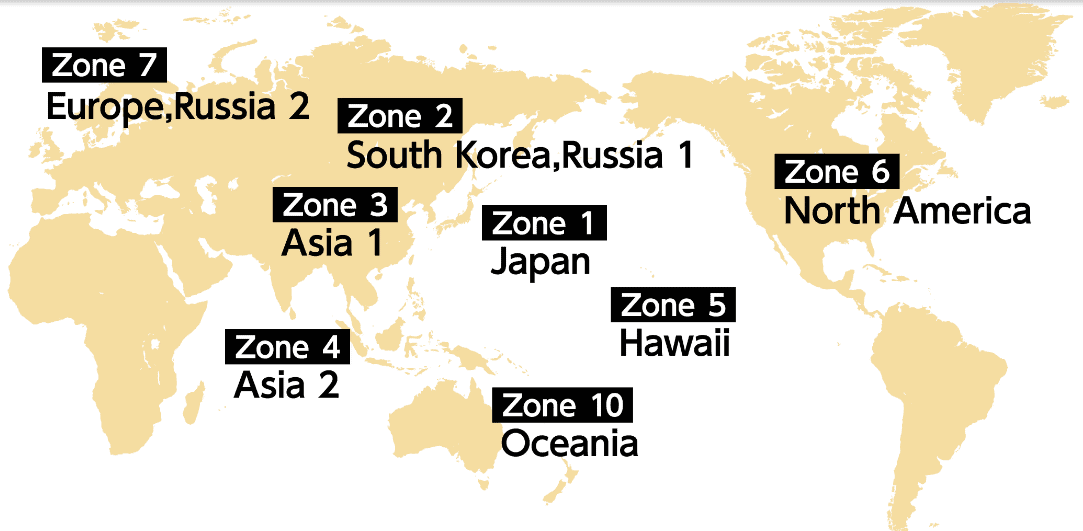
For ANA-operated international flights, the award chart is broken down further based on seasonality: Low season (L), Regular season (R) and High season (H). You can find the seasonality charts for each zone on ANA’s website, which you’ll need to know to work out how each flight in your itinerary will be priced.
Here’s an overview of the roundtrip award rates for ANA-operated flights to India from the U.S.
| Class | Number of Miles Required (Round-Trip) - Low Season | Number of Miles Required (Round-Trip) - Regular Season | Number of Miles Required (Round-Trip) - High Season |
|---|---|---|---|
| Y (economy) | 55,000 | 65,000 | 70,000 |
| PY (premium economy) | 84,000 | 94,000 | 99,000 |
| C (business) | 125,000 | 132,000 | 135,000 |
| F (first) | 195,000 | 215,000 | 245,000 |
These are some incredibly lucrative rates to take you halfway around the world and back in economy, business or first class. The only drawback is that fuel surcharges can cost you a few hundred dollars, so keep that in mind when searching for award fares.
When estimating the number of miles required, the pricing will be determined by the highest season on each leg. This is important to understand as you’ll need to consider the seasonality on each leg. Since you’ll be routing through Japan on your way to India, you’ll have to consider the following:
- The seasonality between the U.S. and Japan on your outbound flight
- The seasonality between Japan and India on your outbound flight
- The seasonality between India and Japan on your return flight
- The seasonality between Japan and the U.S. on your return flight
For example, if your outbound flight to Japan is during the high season and your onward flight from Japan to India is during the regular season, the outbound leg will be priced as if both flights took place during the high season. Likewise, if your return flight from India to Japan is during the regular season and your flight from Japan to the U.S. is during the low season, both fares will be charged using regular season award rates.
Despite this added complexity, scoring ANA award fares from the U.S. to India is an absolute bargain and a solid use of your miles, making it well worth the extra effort.
ANA’s partner award chart is slightly simpler, removing seasonality from the equation. However, the prices are typically higher compared to booking ANA-operated flights, although the fuel surcharges are often far lower. You’ll still have to book a round-trip flight, which can be a bit limiting if award availability isn’t there, but the prices are still some of the lowest you’ll find for flying to India.
For partner award flights from the U.S. to India, you’ll pay the following rates depending on the class of service booked:
| Class | Number of Miles Required (Round-Trip) |
|---|---|
| Y (economy) | 80,000 |
| C (business) | 136,000 |
| F (first) | 240,000 |
Premium economy isn’t available for partner-operated award flights booked through ANA.
Flying business class to India and back for just 136,000 miles or economy for 80,000 miles is a sweet deal if you can find availability. However, there are other programs you can use for better value on Star Alliance first-class flights.
How To Earn ANA Mileage Club Miles
You can transfer American Express Membership Rewards points to ANA Mileage Club miles at a 1:1 ratio, making it the best transfer partner for ANA.
You can also transfer Marriott Bonvoy points to ANA Mileage Club miles at a 3:1 ratio, with a points boost of 5,000 miles for every 60,000 points transferred.
While ANA does have a co-branded credit card—the ANA Card U.S.A, co-issued by the First National Bank of Omaha—it offers limited value for an annual fee of $70.
Therefore, you’re better off sticking to Amex transfers when booking award flights with, or through, ANA.

American Airlines AAdvantage
American Airlines is one of the few U.S. carriers to operate nonstop flights from the U.S. to India, and you can fly out of New York.
However, as American Airlines uses dynamic pricing for their award fares, you’re typically better off using your AAdvantage miles to book a partner award fare. Luckily, American Airlines is part of the Oneworld alliance, opening up your redemption opportunities to include airlines such as Qatar Airways, Cathay Pacific, Japan Airlines and many more.
Just remember to skip British Airways to avoid their exorbitant fuel surcharges.
American Airlines uses the following award chart for partner award flights from the U.S. to India:
| Class | Number of Miles Required (One-Way; Starting From) |
|---|---|
| Economy | 40,000 |
| Premium Economy | 62,500 |
| Business/First | 70,000 |
| First | 115,000 |
That means you’re looking at 80,000 miles for a roundtrip economy award fare, 140,000 miles for a roundtrip business award fare and 230,000 miles for a roundtrip first-class award fare. These are excellent rates, particularly since you could land yourself in a luxurious Qatar Qsuite on your way to India.
How To Earn AAdvantage Miles
Earning AAdvantage miles is trickier than earning other frequent flyer miles, but it’s getting easier with the addition of Citi as a transfer partner.
In terms of transfer partners, Citi is the only 1:1 partner, with Marriott Bonvoy allowing you to transfer your points to AAdvantage at a 3:1 ratio, with a points boost of 5,000 miles for every 60,000 points transferred.
Citi Bank acquired Barclays’ AAdvantage credit card portfolio, so while there used to be two card issuers for American Airlines co-branded cards, Citi is now the only issuer for these cards. They offer several co-branded American Airlines cards.
Avianca LifeMiles
Avianca LifeMiles is another program to consider when booking award fares to India. It’s part of the Star Alliance, making it a great tool for booking award fares with airlines such as Air India, United Airlines, Turkish Airlines and ANA.
Avianca doesn’t have a published partner award chart, making it difficult to know what you’ll pay until you search. However, one of the standout benefits of the program is that fuel surcharges aren’t tacked on to your award fares, which reduces your out-of-pocket cost significantly.
Generally speaking, you can expect to pay about 47,000 miles for a one-way economy award fare, 90,000 miles for a business award fare and 120,000 miles for a first-class award fare.
How To Earn Avianca LifeMiles
Avianca LifeMiles are simple to earn.
You can transfer your American Express Membership Rewards points, Bilt points, Capital One miles, Citi ThankYou points and Wells Fargo points to Avianca LifeMiles at a 1:1 transfer ratio, making it a highly flexible program.
Marriott Bonvoy points also transfer to Avianca LifeMiles at a 3:1 ratio, with a points boost of 5,000 miles for every 60,000 points transferred.
If you fly frequently with Avianca, you could also consider opening one of their co-branded credit cards—the Avianca Lifemiles American Express Card and Avianca Lifemiles American Express Elite Card. That way, you can earn miles on everyday spending as well as enjoy airline-specific perks as a cardholder.
Keep in mind that these cards only use the American Express processing network and are issued by Cardless—a Fintech company—meaning that they’re not subject to Amex’s typical card rules.
However, in most cases, you’re better off sticking to a general travel rewards card and transferring your points to Avianca. That way, you’ll benefit from better earning rates and greater redemption flexibility.
Turkish Airlines Miles&Smiles
Turkish Airlines Miles&Smiles is one of your best options for getting to India.
Turkish has two award charts to navigate, both of which offer lucrative redemptions: an award chart for Turkish-operated flights and a partner award chart.
The award chart for Turkish Airlines-operated flights prices its awards based on the region that the departure and arrival destinations fall into, the number of segments and class. It also splits into “promotional” award tickets and standard award tickets, the former of which offers significant discounts on award fares.
For flights operated by Turkish Airlines from the U.S. to India, the following award rates apply:
- U.S. to Turkey: Economy flights are 40,000 miles one-way and business flights are 65,000 miles one-way with promotional pricing. For standard award tickets, you’ll pay 55,000 miles for a one-way economy award fare and 135,000 miles for a business-class award fare.
- Turkey to India: Economy flights cost 20,000 miles one-way and business flights cost 35,000 one-way miles with promotional pricing. For standard award tickets, you’ll pay 25,000 miles for a one-way economy award fare and 50,000 miles for a business-class award fare.
To work out the total cost of your trip to India and back with Turkish Airlines, you need to add up the prices of each segment:
- Promotional economy class: 60,000 miles one-way and 120,000 round-trip
- Promotional business class: 100,000 miles one-way and 200,000 miles round-trip
- Standard economy class: 80,000 miles one-way and 160,000 miles round-trip
- Standard business class: 185,000 miles one-way and 370,000 miles round-trip
You can also use the Turkish Mileage Calculator to find out how many miles are needed for a redemption.
For partner award fares booked through Turkish, calculating your award fares is easier as pricing isn’t per segment. Instead, the price of your award ticket is based simply on the class and geographic zones you’re flying between.
Here’s an overview of what you’ll pay when booking flights from the U.S. to India with Turkish’s partner airlines:
| Class | Number of Miles Required (One-Way) |
|---|---|
| Economy | 60,000 |
| Business | 100,000 |
| First | 150,000 |
These are incredibly low award rates, allowing you to fly to India and back for just 120,000 miles round-trip in economy, 200,000 miles in business and 300,000 miles in first class.
By using Turkish Miles&Smiles, you could score cheap award fares with other partner airlines including Lufthansa, ANA, Air India, United Airlines and Air Canada. Considering both Air India and United Airlines operate nonstop flights from the U.S. to India, these are great partners to book using Turkish miles.
Just be aware that it’s often easier to book over the phone with Turkish and to search for award availability through other Star Alliance partner websites, such as United and Air Canada.
How To Earn Turkish Airlines Miles&Smiles
You can transfer Bilt points, Capital One miles and Citi ThankYou points to Turkish Miles&Smiles at a 1:1 transfer ratio.
You can transfer Marriott Bonvoy points to Turkish Miles&Smiles at a 3:1 ratio, with a points boost of 5,000 miles for every 60,000 points transferred.
You could consider applying for the Turkish Airlines Miles&Smiles Premier Visa Signature® Credit Card, but you’d likely be better off transferring your flexible points from general travel rewards credit cards.

Virgin Atlantic Flying Club
If you want to score flights to India with Air France or KLM at a lower price than what you’d pay by booking directly with these airlines, you can leverage your Virgin points.
Virgin Atlantic Flying Club has a zone-based award chart for Air France and KLM flights. India falls into Zone 5, while the East Coast* falls into Zone 6 and the West Coast** into Zone 7. Prices vary depending on whether your travel dates are off-peak or peak.
Here’s an overview of the award rates you can expect to pay when booking Air France or KLM flights through Virgin Atlantic Flying Club.
| Class | Number of Miles Required (One-Way) - Off-Peak - Zone 6 | Number of Miles Required (One-Way) - Off-Peak - Zone 7 | Number of Miles Required (One-Way) - Peak - Zone 6 | Number of Miles Required (One-Way) - Peak - Zone 7 |
|---|---|---|---|---|
| Economy | 28,000 | 31,000 | 38,000 | 41,000 |
| Premium Economy | 56,000 | 62,000 | 72,000 | 76,000 |
| Business | 110,000 | 122,500 | 120,000 | 132,500 |
If you’re flying from the East Coast, you could pay as little as 56,000 miles round-trip during off-peak travel dates and 84,000 miles during peak travel dates in economy class. If you opt to fly business from the East Coast, you’d pay 220,000 miles off-peak round-trip and 240,000 miles during peak travel dates.
These are highly competitive rates, which you can take advantage of when looking for Air France and KLM flights to India.
*East Coast includes the following U.S. states: Alabama, Connecticut, Delaware, Florida, Georgia, Illinois, Indiana, Kentucky, Maine, Maryland, Massachusetts, Michigan, Mississippi, New Hampshire, New Jersey, New York, North Carolina, Ohio, Pennsylvania, Rhode Island, South Carolina, Tennessee, Vermont, Virginia, Washington D.C., West Virginia and Wisconsin.
**West Coast includes the following U.S. states: Alaska, Arizona, Arkansas, California, Colorado, Hawaii, Idaho, Iowa, Kansas, Louisiana, Minnesota, Missouri, Montana, Nebraska, Nevada, Nevada, New Mexico, North Dakota, Oklahoma, Oregon, South Dakota, Texas, Utah, Washington and Wyoming.
How To Earn Virgin Atlantic Flying Club Points
You can transfer American Express Membership Rewards points, Bilt points, Capital One miles, Chase Ultimate Rewards, Citi ThankYou points and Wells Fargo points to Virgin Atlantic Flying Club at a 1:1 transfer ratio.
You can also transfer Marriott Bonvoy points to Virgin Atlantic Flying Club points at a 3:1 ratio, with a points boost of 5,000 miles for every 60,000 points transferred.
For frequent flyers with Virgin, you could consider opening the Virgin Red Rewards Mastercard® to earn miles on your everyday spending and enjoy exclusive cardholder perks.
Final Thoughts
When planning the trip of a lifetime to the Asian subcontinent, you have a wide range of airlines to choose from. Whether you want to fly economy, business or first class, you’ll be able to get to India and back using points and miles, with minimal out-of-pocket costs.
So, whether you’re headed North to the Himalayas, West to the jungles or South to the beaches, you’ll have more to spend on world-class food and experiences because you saved all that cash on flights.
Sign up for our free 10xTravel course today to learn how you can leverage your everyday expenses to earn you thousands of points and miles for travel.

New to the world of points and miles? The Chase Sapphire Preferred® Card is the best card to start with.
With a bonus of Earn 75,000 bonus points after you spend $5,000 on purchases in the first 3 months from account opening. , 5x points on travel booked through the Chase TravelSM Portal and 3x points on restaurants, streaming services, and online groceries (excluding Target, Walmart, and wholesale clubs), this card truly cannot be beat for getting started!
Editors Note: Opinions expressed here are author’s alone, not those of any bank, credit card issuer, hotel, airline, or other entity. This content has not been reviewed, approved or otherwise endorsed by any of the entities included within the post.
10xTravel is part of an affiliate sales network and receives compensation for sending traffic to partner sites, such as CreditCards.com. This site may earn compensation when a customer clicks on a link, when an application is approved, or when an account is opened. This compensation may impact how and where links appear on this site. This site does not include all financial companies or all available financial offers. Terms apply to American Express benefits and offers. Enrollment may be required for select American Express benefits and offers. Visit americanexpress.com to learn more. All values of Membership Rewards are assigned based on the assumption, experience and opinions of the 10xTravel team and represent an estimate and not an actual value of points. Estimated value is not a fixed value and may not be the typical value enjoyed by card members.
Editors Note: Opinions expressed here are author’s alone, not those of any bank, credit card issuer, hotel, airline, or other entity. This content has not been reviewed, approved or otherwise endorsed by any of the entities included within the post.

bonus cash back
after you spend $6,000 on purchases in the first 3 months from account opening.

earn 75K bonus miles miles
once you spend $4,000 on purchases within 3 months from account opening.
bonus points
after you spend $5,000 on purchases in the first 3 months from account opening.
Membership Rewards® Points
after you spend $8,000 in eligible purchases on your new Card in your first 6 months of Card Membership. Welcome offers vary and you may not be eligible for an offer. Apply to know if you’re approved and find out your exact welcome offer amount – all with no credit score impact. If you’re approved and choose to accept the Card, your score may be impacted.