10xTravel is part of an affiliate sales network and receives compensation for sending traffic to partner sites, such as CreditCards.com. This site may earn compensation when a customer clicks on a link, when an application is approved, or when an account is opened. This compensation may impact how and where links appear on this site. This site does not include all financial companies or all available financial offers. Terms apply to American Express benefits and offers. Enrollment may be required for select American Express benefits and offers. Visit americanexpress.com to learn more. All values of Membership Rewards are assigned based on the assumption, experience and opinions of the 10xTravel team and represent an estimate and not an actual value of points. Estimated value is not a fixed value and may not be the typical value enjoyed by card members.
Note: Some of the offers mentioned below may have changed or may no longer be available. The content on this page is accurate as of the posting date; however, some of our partner offers may have expired. You can view current offers here.
For years, Chase has reigned as the most popular credit card issuer in the United States market. Chase has a wide variety of credit card offerings that appeal to many different consumers, including a high-annual-fee luxury card with a bevy of statement credits and annual benefits (the Chase Sapphire Reserve® card) as well as a no-annual-fee cashback business card with a flat rewards rate for business owners (the Ink Business Unlimited® Credit Card).
Another reason that Chase is such a popular issuer is the Chase Ultimate Rewards program, which has earned a reputation as one of the best credit card rewards programs out there. This program allows members to earn Chase points by spending on Chase credit cards (as well as in several other ways) and then redeem those points for statement credits, gift cards, travel and more.
Most other credit card programs function in essentially the same way. However, due to the different redemption options offered by each program, not all credit card points have the same value. So, how much are Chase points worth?
In this article, we’ll determine the value of Chase Ultimate Rewards points and examine the factors that contribute to this currency’s value.

Earn 100,000
bonus points
after you spend $6,000 on purchases in the first 3 months from account opening.
Annual Fee: $795

Why Do Chase Rewards Points Hold Value?
In examining the value of a credit card rewards currency like Chase Ultimate Rewards points, there are several main contributing factors:
- How easy is it to earn points?
- How much is each point worth through each available redemption method?
- How much value can you potentially get through the rewards program’s transfer partners?
First off, earning points with Chase Ultimate Rewards is very easy. This issuer has a credit card that suits nearly every consumer, and all of these Chase credit cards allow you to rack up points on every purchase you make.
And, some of these cards offer super-high spending bonuses in specific categories. For example, the Chase Sapphire Reserve® card earns 8X points on purchases made through the Chase Travel℠ portal. If you want to learn about all of the other spending bonuses and benefits offered by this card, check out our Chase Sapphire Reserve review.
There are also a few other ways to earn Chase points other than credit card spending, including Refer-A-Friend bonuses and making purchases with Shop Through Chase. These options make it even easier to quickly rack up Chase points.
Which Redemption Options Give the Best Value of Chase Points?
There are several different ways you can redeem Chase Ultimate Rewards points, some of which offer very different values per point. In the following sections, we’ll rank all Chase Ultimate Rewards redemption methods from worst to best.
Worst: Amazon and PayPal (0.8 Cents Per Point)
The worst way that you can use Chase Ultimate Rewards points is to redeem them for purchases through Amazon or PayPal. These redemption methods offer a value of 0.8 cents per point, which is very poor.
For instance, if you were to use your Chase points to cover an Amazon purchase that costs $100, you’d have to pay 12,500 points, which is a bad deal.
You’d be much better off using your Chase credit card to make your Amazon or PayPal purchase with cash, earn Chase points on that purchase and then redeem your Chase points for a statement credit at a rate of 1 cent per point.
Poor: Statement Credits, Gift Cards, Cash Back and Most Chase Travel℠ Redemptions (1 Cent Per Point)
Chase Ultimate Rewards points can also be redeemed for statement credits, gift cards and cash back. All of these redemption methods convert Chase points to dollars at a rate of 1 cent apiece, which is poor compared to the value you can get from other redemption methods (as we’ll discuss later). Nonetheless, if you aren’t interested in booking travel with your Chase points, then redeeming them for statement credits or cash back is actually your best and most practical option.
The majority of travel redemptions available through the Chase Travel℠ portal also offer 1 cent per point in value, regardless of which credit card you have. Up until 2025, the Sapphire Reserve card got a baseline value of 1.5 cents per point through Chase Travel℠, and the Sapphire Preferred and Ink Business Preferred cards got a baseline value of 1 cent per point through Chase Travel℠.
Unfortunately, the Chase Travel℠ portal experienced a major devaluation in 2025, and the vast majority of travel redemptions available through this portal now offer just 1 cent per point in value, regardless of which credit card you have. The exceptions to this rule are Points Boost redemptions.
Better: Points Boost Redemptions Through Chase Travel℠ (1.5 – 2 Cents Per Point)
Certain Chase cardholders can occasionally find redemptions through the Chase Travel℠ portal that offer up to 2 cents per point in value. These redemptions are marked with a Points Boost tag and, in fact, you can filter for only Points Boost redemptions in your Chase Travel℠ search results by turning on the “Points Boost” toggle button.
The value that you’ll get out of a Points Boost redemption depends on the specific redemption as well as the Chase credit card you’re using. The following table includes the value you can get out of Points Boost redemptions with each eligible Chase credit card:
| Chase card name | Value of Points Boost flight redemptions |
|---|---|
| Chase Sapphire Preferred® Card | Up to 1.5 cents per point |
| Chase Sapphire Reserve® | 1.75 - 2 cents per point |
| Ink Business Preferred® Credit Card | 1.5 - 1.75 cents per point |
| Sapphire Reserve for Business℠ | 1.75 - 2 cents per point |
As you can see, with these Points Boost redemptions, you can get double the value of a normal Chase Travel℠ redemption with the Chase Sapphire or Chase Sapphire for Business card, and add up to 50-75% more value with the Sapphire Preferred or Ink Business Preferred card.
For this reason, we recommend not redeeming Chase points through the Chase Travel℠ portal unless they’re for a Points Boost redemption.
Best: Transfer to Partner Travel Rewards Programs (Potentially > 2 Cents Per Point)
In many cases, the best way to maximize the value of your points is to transfer them to one of Chase’s transfer partners. Through these partner loyalty programs, you could potentially get several cents per point in value on certain redemptions.
Here’s the current list of Chase Ultimate Rewards transfer partners, all of which offer a 1:1 transfer ratio:
- Aer Lingus AerClub
- Air Canada Aeroplan
- Air France-KLM Flying Blue
- British Airways Executive Club
- Iberia Plus
- IHG One Rewards
- JetBlue TrueBlue
- Marriott Bonvoy
- Singapore Airlines KrisFlyer
- Southwest Airlines Rapid Rewards
- United Airlines MileagePlus
- Virgin Atlantic Flying Club
- World of Hyatt
To redeem points with transfer partners, you can visit your Chase Ultimate Rewards dashboard and click on “Earn/Use” and then select the “Transfer to Travel Partners” option that appears in the drop-down menu.
Then, you can select your desired transfer partner and the number of points you want to transfer. However, we highly recommend identifying the exact redemption you want to make through a transfer partner before actually completing your transfer. These transfers can’t be reversed.
While some redemptions through certain transfer partners offer value considerably higher than 2 cents per point, other partner travel redemptions offer 1 cent per point or less. So, it’s important to calculate the value of a partner redemption before making your transfer.
To assess the value of a specific partner redemption, take the normal cash price of a flight and then divide it by the award rate. For example, let’s say the cash price of a flight was $500 and the award rate was 25,000 Flying Blue miles. Then, since Chase points transfer to the Flying Blue program at a 1:1 ratio, the value of this redemption would be 2 cents per point ($500 / 25,000 miles = 2 cents per point).
These are the types of calculations you should do when assessing potential partner travel redemptions. And, in comparing these values, you can decide which redemptions are the best uses of your points.
How Do Transfer Partners Impact the Value of Chase Points?
While most Chase Ultimate Rewards redemption options offer 1 cent per point or less, you could potentially get several cents per point in value by redeeming your points through Chase’s transfer partners. Thus, these transfer partners push up the average value of Chase points.
For example, one of Chase’s best transfer partners is World of Hyatt. Through this program, we found a redemption for a stay at the Andaz Maui at Wailea Resort for 35,000 points per night in a standard room (which is in the Lowest level price bracket for a Category 8 Hyatt hotel) in September 2026.
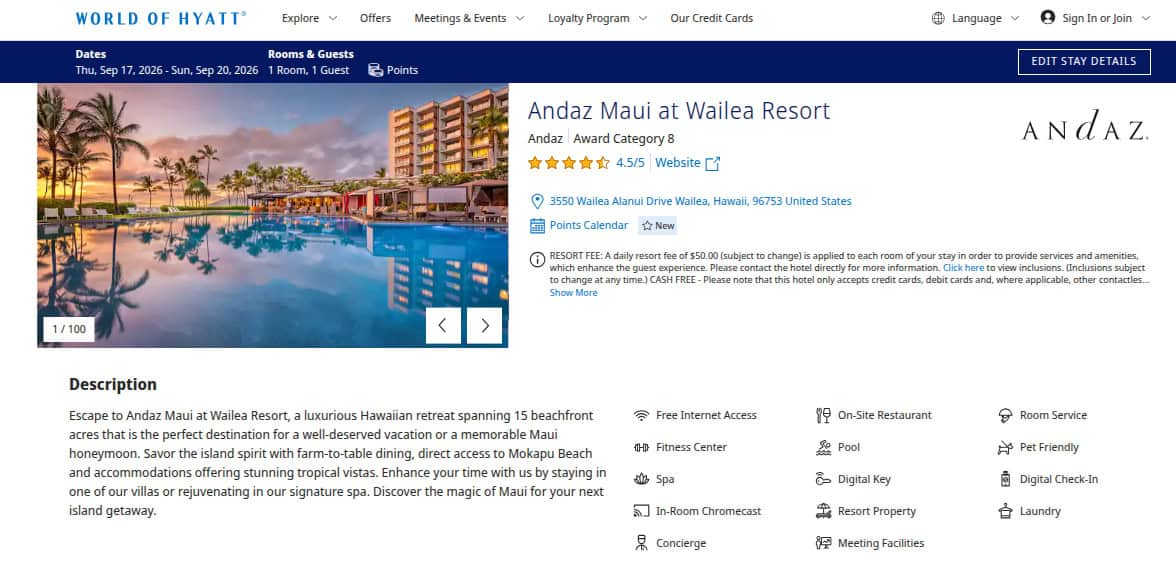

If you were to book the exact same room on the same night with cash instead of points, it would cost you $802 per night.

Thus, this redemption would give you a value of about 2.3 cents per point, which is higher than any value you can get through the Chase Travel℠ portal or through any other redemption method.
Through transfer partners like World of Hyatt and others, you can often find redemptions that offer this much value or even more. So, primarily because of these transfer partners, Chase Ultimate Rewards points are potentially worth much more than 1 cent apiece.
How to Maximize the Value of Chase Points
Generally, the best value per point that you can find through the Chase Ultimate Rewards program is through transfer partners. However, not all transfer partners offer the same value, not all types of redemptions through partners offer the same value, and there are certain pitfalls you should avoid when redeeming Chase points.
What Are the Best Travel Redemptions for Chase Points?
The highest potential value per point that you can find through Chase Ultimate Rewards is through transfer partners. However, not all transfer partners offer the same value. And, within each partner travel loyalty program, values can vary from redemption to redemption.
Generally, some of the Chase transfer partners that tend to offer the most value per point on average include World of Hyatt, JetBlue TrueBlue, Singapore Airlines KrisFlyer and Virgin Atlantic Flying Club. By searching for redemptions through these partners, you can often find several cents per point in value and maximize the benefit you get out of your Chase points.
Additionally, premium-cabin flight awards tend to offer more value per point than economy-class flight awards. Of course, an economy-class flight will get you to your destination with fewer points. But premium-cabin awards typically provide more value per point.
Likewise, when redeeming Chase points through hotel transfer partners, you’ll typically get better value per point when booking with more expensive luxury hotels than with budget hotels.
What Mistakes Lower the Value of Chase Rewards Points?’
Just as it’s important to be frugal with your cash, as a savvy credit card user, you understand that it’s important to be discerning in how you spend your credit card points. And this means avoiding mistakes that can lower the value of your points.
Let’s look at a few common mistakes that may prevent you from maximizing the value of your Chase points.
Ignoring Taxes and Fees on Travel Redemptions
One mistake that newcomers to the world of points and miles often make is ignoring the effect of taxes and fees on the value of a redemption. In some cases, a redemption may look like the best option because it requires fewer points or miles. However, if that redemption carries high taxes and fees, then it may not actually be the best value.
For example, let’s say the same flight is available as an award through both the British Airways Executive Club and Air France-KLM Flying Blue programs for the following prices:
- 50,000 British Airways Avios and $20 in taxes and fees
- 35,000 Flying Blue miles and $175 in taxes and fees
It might appear that the Flying Blue redemption is the better option because it requires fewer miles. However, when you factor the taxes and fees into your calculation, you’ll see that the British Airways Executive Club redemption actually provides more value.
So, when comparing the values of specific redemptions, make sure to factor in the taxes and fees in your calculations.
Not Paying Off Credit Balances In Full
Regardless of how many Chase points you’re earning, you might actually still be getting negative value from your credit card if you’re carrying a balance from month to month. That’s because every month that you don’t pay off your balance in full, you’re being charged interest on the unpaid balance. And the interest rate (or APR) charged by credit cards can be very high.
Let’s say you’re carrying a balance that incurs $50 in interest each month. If you’re incurring this charge month after month while also earning 4,000 Chase points monthly (which are worth a little more than $40), then you’d be getting net negative value from your credit card.
So, before you get too excited about the rewards that you’re earning from all of the spending you’re doing on your Chase credit card, you may want to consider cutting back your spending and paying off your credit balance. Even if it looks like you’re earning a ton of rewards points, the value of those points may be offset by your interest charges if you’re carrying a balance from month to month.

Which Chase Cards Offer the Best Points Value?
Once again, the best way to maximize the value of Chase Ultimate Rewards points is to transfer them to partner hotel and airline rewards programs and purchase redemptions that offer outsized value.
However, not all Chase credit cards allow you to transfer your points to these partner loyalty programs. If you want to access these Chase transfer partners, you’ll need to have one of the following personal cards:
- Chase Sapphire Preferred® Card
- Chase Sapphire Reserve®
And if you’re a business owner, you’ll need one of these business cards:
- Ink Business Preferred® Credit Card
- Sapphire Reserve for Business℠
Only these four cards currently allow you to transfer your Chase Ultimate Rewards points to transfer partners, allowing you to redeem them for outsized value.
These four cards are also the only Chase cards that have access to Points Boost redemptions through the Chase Travel℠ portal (which offer between 1.5 and 2 cents per point). So, if you don’t have one of the four credit cards listed above, the maximum value you can get out of your Chase points is 1 cent apiece.

Chase Sapphire Preferred® Card
Earn 75,000
bonus points
after you spend $5,000 on purchases in the first 3 months from account opening.
Annual Fee: $95
Earn 100,000
bonus points
after you spend $6,000 on purchases in the first 3 months from account opening.
Annual Fee: $795
What Makes Sapphire Card Redemptions Stand Out?
Chase Sapphire credit cards are the premier credit cards in Chase’s lineup. These cards all charge an annual fee (either $95 or $795), but they also unlock a lot more value when redeeming your Chase Ultimate Rewards points.
With all non-Sapphire cards (with the lone exception of the Ink Business Preferred card), the maximum value you can get out of your Chase points is 1 cent apiece.
By contrast, Sapphire cards (and the Ink Business Preferred) have access to Points Boost redemptions through the Chase Travel℠ portal, which offer between 1.5 and 2 cents per point in value.
All Sapphire cards and the Ink Business Preferred also have access to Chase’s transfer partners. Through these transfer partners, you can often find redemptions far exceeding 2 cents per point in value.
So, by adding a Sapphire card to your wallet, you’re largely increasing the potential value you could get out of your Chase points.
Are Chase Business Cards Worth It for Points Collectors?
If you’re a small-business owner, adding a Chase business credit card to your wallet can be a powerful organizational tool and a great way to earn even more Chase points on your business-related purchases.
By using a business credit card, you can ensure that you keep your business and personal expenses separate, which will make your accounting much easier. Plus, these cards can help you build your business credit, which can help you get approved for a business loan.
Here are the business credit cards currently offered by Chase, as well as each card’s annual fee:
- Ink Business Cash® Credit Card ($0 annual fee)
- Ink Business Preferred® Credit Card ($95 annual fee)
- Ink Business Unlimited® Credit Card ($0 annual fee)
- Sapphire Reserve for Business℠ ($795 annual fee)
One other major advantage of Chase’s business credit cards is that they tend to offer elevated spending bonuses in categories that aren’t covered by Chase’s personal credit cards. For example, both the Ink Business Preferred and the Sapphire Reserve for Business offer 3X points on social media and search engine advertising, which is a category that isn’t covered by any of Chase’s personal credit cards.
So, if you’re a small business owner, you should consider adding one of Chase’s business credit cards to your credit card strategy.
Smart Ways to Earn More Chase Rewards Points
The best way to earn as many Chase Ultimate Rewards points as possible is to optimize your Chase credit card strategy. This may mean signing up for more than one Chase card since different Chase cards offer elevated spending bonuses in different categories.
Consider a Multi-Card Strategy
If you currently have just one Chase credit card, then you may be missing out on points you could be earning with a multi-card strategy. One of the best multi-card strategies for maximizing your Chase Ultimate Rewards points earnings is to sign up for the Chase Sapphire Preferred, Chase Freedom Flex® and Chase Freedom Unlimited®.
The following table includes the spending bonuses and annual fees for these three cards:
| Card name | Chase Sapphire Preferred® Card | Chase Freedom Unlimited® | Chase Freedom Flex® |
| Annual fee | $0 | $0 | |
| Spending bonuses |
|
|
|
*Chase Freedom Flex quarterly rotating categories have historically included PayPal purchases, gas and EV charging stations, select live entertainment, pet shops and veterinarian services, self-care and spa services, movie theatres, Walmart, Lowe’s and more.
As you can see, each of these cards has its own advantages in terms of spending bonuses. Here’s how you should use each of these cards’ spending bonuses:
- Use your Freedom Flex card for all purchases in your rotating quarterly category and earn 5% cash back.
- Use your Sapphire Preferred card to pay for all travel, dining, grocery purchases and streaming services and earn between 5X and 2X points on those purchases.
- Use either your Freedom Unlimited card or Freedom Flex card for drugstore purchases and earn 3% cash back.
- Use your Freedom Unlimited card to pay for all purchases that don’t qualify for any of the aforementioned spending bonuses and earn 1.5% cash back.
With this strategy, you can ensure that you’re maximizing your Chase Ultimate Rewards points earnings. And you’ll only have to pay a combined annual fee of $95. Plus, since you have the Sapphire Preferred card, you can pool all of your points in your Sapphire Preferred account and use them all through transfer partners.

Limited Time Offer! Earn a $250
Bonus
after you spend $500 on purchases in your first 3 months from account opening

Earn a $200
Bonus
after you spend $500 on purchases in your first 3 months from account opening
How Can You Combine Chase Cards for Maximum Rewards?
Despite the fact that you can only access Chase’s list of transfer partners if you have the Sapphire Reserve, Sapphire Reserve for Business, Sapphire Preferred or Ink Business Preferred card, it’s worth noting that you can transfer points between Chase credit accounts.
And, if you have one of Chase’s cashback cards (such as the Chase Freedom Unlimited® or Ink Business Cash® Credit Card) as well as one of the four cards listed above, you can transfer points from your cashback account to your Sapphire account and then use those points through transfer partners.
For example, let’s say you’re a business owner and you have both the Chase Sapphire Preferred and Ink Business Unlimited cards. These cards actually complement each other fairly well, since the Sapphire Preferred earns a baseline of 1X points and the Ink Business Unlimited offers 1.5% cash back on all purchases. Thus, all purchases that don’t qualify for an elevated spending bonus with the Sapphire Preferred can be put on the Ink Business Unlimited and earn a higher rewards rate.
Plus, the Ink Business Unlimited earns cash back in the form of Chase Ultimate Rewards points, which can’t be redeemed through transfer partners when they’re in your Ink Business Unlimited account. However, when you transfer those points from your Ink Business Unlimited account to your Sapphire Preferred account, you can then use them through transfer partners, thus significantly increasing their value.

Build Your Chase Points Strategy
The Chase Ultimate Rewards program recently underwent a serious devaluation as Chase cardholders now get a baseline value of 1 cent per point through the Chase Travel℠ portal, regardless of which Chase card they have. Before July 2025, Sapphire Reserve cardholders got 1.5 cents per point, and Sapphire Preferred and Ink Business Preferred cardholders got a baseline of 1.25 cents per point through Chase’s travel portal.
So, despite the fact that you can still get up to 2 cents per point on certain “Points Boost” redemptions through Chase Travel℠, changes still had a negative effect on the Chase Ultimate Rewards points value that should cause Chase cardholders to rethink their points strategies.
Now, no matter what kind of Chase card you have, we’d recommend first looking into spending your points on travel through transfer partners (specifically high-value partners such as World of Hyatt, JetBlue TrueBlue, Singapore Airlines KrisFlyer and Virgin Atlantic Flying Club). Redemptions through these partners provide the highest potential value.
However, if you can’t find your desired redemption through transfer partners, it’s worth looking to see if it’s offered as a Points Boost redemption through the Chase Travel℠ portal.
Other than that, most other Chase redemptions now offer just 1 cent per point in value. And, at that value, you’re better off making your purchase with cash, earning points for your purchase and then redeeming your Chase points for a statement credit to cover that purchase.

New to the world of points and miles? The Capital One Venture Rewards Credit Card is the best card to start with.
Current offer: Limited Time Offer: Enjoy a $300 stays credit, plus earn 75K bonus miles once you spend $4,000 on purchases within 3 months from account opening.
Earn 5X miles on hotels, vacation rentals and rental cars booked through Capital One Travel; 2X miles on all purchases.
after you spend $6,000 on purchases in the first 3 months from account opening.
Annual Fee: $795

after you spend $30,000 on purchases in your first 6 months from account opening
Annual Fee: $795
after you spend $8,000 on purchases in the first 3 months from account opening.
Annual Fee: $95
after you spend $6,000 on purchases in the first 3 months from account opening.
when you spend $6,000 on purchases in the first 3 months after account opening.
after you spend $500 on purchases in your first 3 months from account opening
after you spend $500 on purchases in your first 3 months from account opening
Editors Note: Opinions expressed here are author’s alone, not those of any bank, credit card issuer, hotel, airline, or other entity. This content has not been reviewed, approved or otherwise endorsed by any of the entities included within the post.
10xTravel is part of an affiliate sales network and receives compensation for sending traffic to partner sites, such as CreditCards.com. This site may earn compensation when a customer clicks on a link, when an application is approved, or when an account is opened. This compensation may impact how and where links appear on this site. This site does not include all financial companies or all available financial offers. Terms apply to American Express benefits and offers. Enrollment may be required for select American Express benefits and offers. Visit americanexpress.com to learn more. All values of Membership Rewards are assigned based on the assumption, experience and opinions of the 10xTravel team and represent an estimate and not an actual value of points. Estimated value is not a fixed value and may not be the typical value enjoyed by card members.
Editors Note: Opinions expressed here are author’s alone, not those of any bank, credit card issuer, hotel, airline, or other entity. This content has not been reviewed, approved or otherwise endorsed by any of the entities included within the post.
bonus cash back
after you spend $6,000 on purchases in the first 3 months from account opening.
earn 75K bonus miles
once you spend $4,000 on purchases within 3 months from account opening.
bonus points
after you spend $5,000 on purchases in the first 3 months from account opening.
Membership Rewards® Points
after you spend $8,000 in eligible purchases on your new Card in your first 6 months of Card Membership. Welcome offers vary and you may not be eligible for an offer. Apply to know if you’re approved and find out your exact welcome offer amount – all with no credit score impact. If you’re approved and choose to accept the Card, your score may be impacted.