10xTravel is part of an affiliate sales network and receives compensation for sending traffic to partner sites, such as CreditCards.com. This site may earn compensation when a customer clicks on a link, when an application is approved, or when an account is opened. This compensation may impact how and where links appear on this site. This site does not include all financial companies or all available financial offers. Terms apply to American Express benefits and offers. Enrollment may be required for select American Express benefits and offers. Visit americanexpress.com to learn more. All values of Membership Rewards are assigned based on the assumption, experience and opinions of the 10xTravel team and represent an estimate and not an actual value of points. Estimated value is not a fixed value and may not be the typical value enjoyed by card members.
Note: Some of the offers mentioned below may have changed or may no longer be available. The content on this page is accurate as of the posting date; however, some of our partner offers may have expired. You can view current offers here.
For decades, travelers have been conditioned to book flights in a single, neat package: an outbound and return flight bundled together as a traditional round-trip ticket. When you’re paying with cash, this habit often serves you well, as airlines routinely reward your loyalty to a single carrier with heavily discounted round-trip flights compared to buying separate one-way tickets.
But when you pivot from paying cash to redeeming credit card points and frequent flyer miles, the old rule about round-trip fares being cheaper changes. In the world of award travel, locking yourself into a round-trip itinerary is one of the easiest ways to miss out on premium-cabin availability, complicate the booking process and limit your flexibility.
Here’s a full breakdown of one-way vs. round-trip flights, including when each type of booking strategy makes sense and how to get the most value from your points.

Why One-Way Flights Often Beat Round-Trip Bookings
Defaulting to a round-trip booking is convenient, but it introduces a significant bottleneck in your award travel strategy. To book a successful round-trip award, you need your chosen carrier to have open seats on the exact dates you want to depart and return. If just one of those legs lacks award space or spikes in price due to peak demand, the entire itinerary falls apart.
By splitting your travel into two separate one-way tickets, you instantly double your odds of finding a great redemption. You gain the freedom to mix and match airlines, alliances and loyalty programs to build your perfect trip, while being able to dip into multiple rewards currencies.
More importantly, because most frequent flyer programs price one-way awards at exactly half the cost of a round trip, you don’t pay a penalty for this added flexibility. You can fly out with a Star Alliance carrier using one points currency and return on a SkyTeam carrier using another, bypassing availability dry spells.
How Award Pricing Works for One-Way Tickets vs. Round-Trip Tickets
Generally speaking, when booking with cash, one round-trip ticket is cheaper than booking the exact same flights as two one-way tickets. Airlines have incentivized round-trip bookings for years by pricing them at a cheaper rate than the combined cost of two one-way fares.
For instance, a round-trip ticket with Delta Air Lines from Minneapolis (MSP) to Dublin (DUB) would cost you $739.83.

Image courtesy of Delta Air Lines
If you booked the exact same flights as two one-way tickets, you’d pay a total of $1,171.
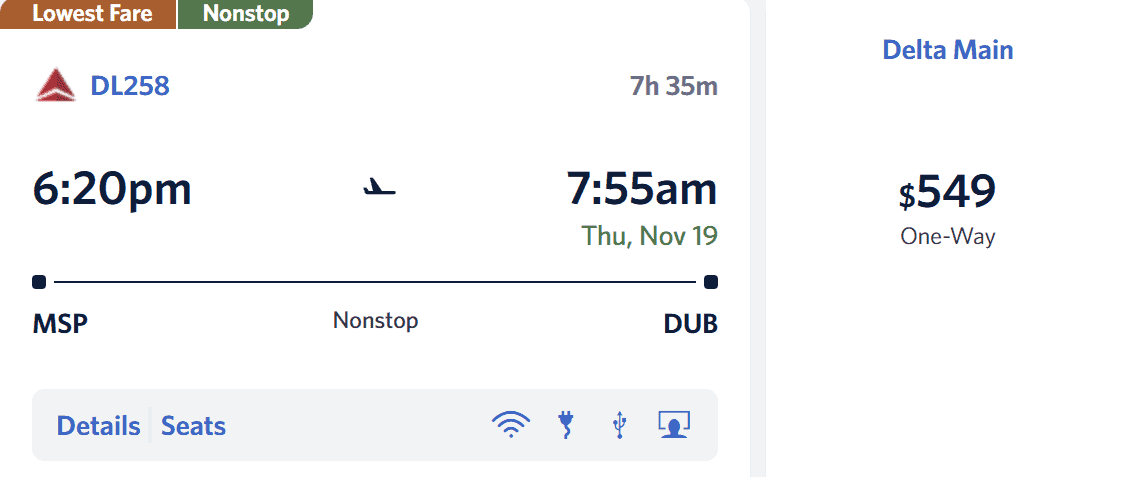
Image courtesy of Delta Air Lines
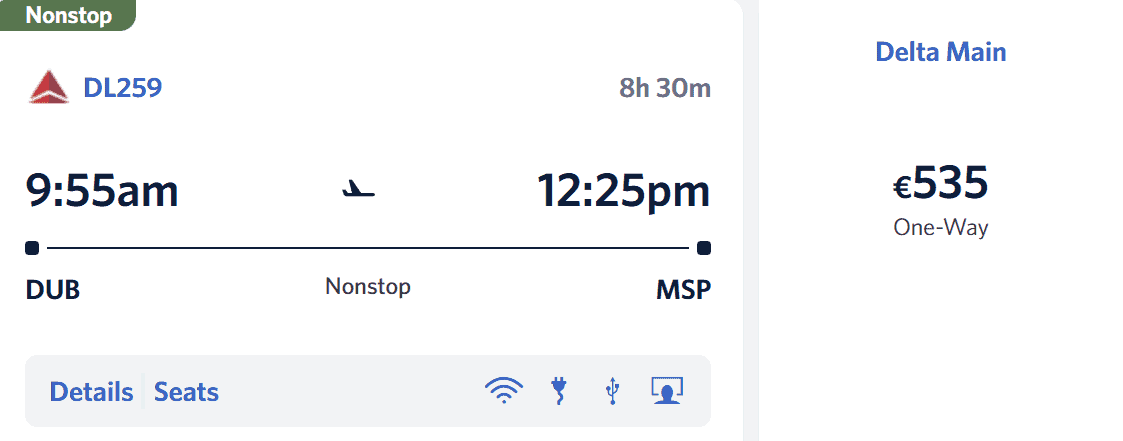
Image courtesy of Delta Air Lines
This isn’t accidental—airlines purposely price one-way tickets higher than round-trip equivalents for the following reasons:
- To secure both legs: By offering a discount on round-trip tickets, the airline disincentivizes you from booking the return leg with a competitor airline.
- To target business travelers: Travelers flying for business often book last-minute one-way tickets for greater flexibility. These travelers can afford higher rates, often because they’re reimbursed by their company.
This strategy applies to both international and domestic fares, although the difference is more pronounced on international routes.
That said, low-cost carriers generally don’t apply this practice. No matter whether you book one-way or round-trip, low-cost carriers usually charge the same rates. On routes where there’s significant competition between low-cost carriers, this can force other airlines to price their one-way tickets more competitively, especially in domestic markets.
When it comes to award tickets, however, the situation looks different. One-way award tickets are usually half the price of round-trip tickets, meaning you won’t save any miles by opting for round-trip vs. one-way flights. For this reason, booking one-way award tickets is often preferable, as it gives you more flexibility for finding award space on both legs of your trip.
It’s important to note that there are some exceptions. Some airline loyalty programs, such as Delta SkyMiles and Emirates Skywards, offer discounts on round-trip award bookings, but these are exceptions rather than the rule.
When Does Splitting a Trip Into Two One-Way Flights Save Miles?
Splitting a round-trip itinerary into two one-way bookings can save you miles when:
- You have fixed travel dates and at least one of those travel days has peak award rates.
- You want to take advantage of regional award chart differences between loyalty programs.
- You’re planning an open-jaw itinerary with flexible dates.
- The cents-per-point value of at least one flight is so low that you’re better off paying cash.
Let’s say you’re flying to visit your family during Thanksgiving and can only fly on certain dates due to work commitments. If at least one of those dates has astronomically high award rates, booking two one-way tickets would allow you to shop around with competitor airlines to find a cheaper fare. You might find an award ticket for a much lower price, or alternatively, you may decide that paying cash is a better option to avoid redeeming your miles at a low value.
Similarly, if you’re planning your dream trip to Europe, booking two one-way award tickets allows you to take advantage of the multiple hubs, routes and airlines spread across the continent. Instead of being locked into one carrier’s route network, pricing and availability schedule, you can shop around with Air France, KLM, Iberia, Lufthansa, Aer Lingus, Swiss International Air Lines and many other European carriers.
This approach also applies to other regions and continents where it’s easy to hop between major international hubs using cheap local carriers.

Best Scenarios for Redeeming Points on One-Way Flights
There are several scenarios when redeeming points for one-way flights is often the best option.
Open-Jaw and Multicity Itineraries
One of the major benefits of booking one-way tickets is flexibility. And nothing says flexibility more than booking an open-jaw or multicity itinerary.
An open-jaw itinerary is one in which you fly into one city and out of a different one. For instance, flying from Chicago-O’Hare (ORD) to Rome (FCO) and back from Paris (CDG) to Chicago (ORD). You can use a cheap positioning flight to get between Rome and Paris in this instance. You can also have double open-jaw itineraries, in which both the cities you fly out of and into are all different, such as Chicago (ORD) to Rome (FCO) and Paris (CDG) to Boston (BOS).
Open-jaw itineraries give you massive flexibility and can be perfect for exploring multiple cities in one trip. This makes them particularly popular for destinations such as Europe, where there are tons of cities to visit and you might not want to backtrack just for the return flight.
You can book open-jaw itineraries as multicity round-trip tickets, and sometimes that can make sense. Multicity trips booked with cash are often priced in the same way as round-trip tickets, making them cheaper than multiple individual one-way bookings. However, if you want to take advantage of different airline premium-cabin products and increase your chances of securing award space, you’re often better off booking one-way tickets.
For instance, you could fly business from Washington (IAD) to Paris (CDG) with Air France, take the train to Berlin for some sightseeing, then take a cheap Ryanair flight to Madrid (MAD) and fly on to New York (JFK) with Iberia in business class. This highlights the advantages of open-jaw itineraries, demonstrating that one-way award flights often beat round-trip bookings when building these trips.
Mixing Airlines and Alliance Partners on Separate Tickets
If you’ve ever tried to redeem points, you’ll know that finding award space can be a challenge. Securing the airline and cabin you want to fly on the correct route and exact dates you want can seem impossible. Trying to find both an outbound and a return ticket makes that task even harder.
By searching for and booking one-way award tickets instead, you have greater flexibility and a better chance of finding a premium-cabin award seat. For example, maybe you can only find economy saver fares from New York (JFK) to Madrid (MAD) with Iberia. But on the return leg, you see award space pop up in Lufthansa business class from Frankfurt (FRA). By booking two one-way tickets with separate carriers, you have greater flexibility to take advantage of award space.
Additionally, because award space is often released to partner loyalty programs at the last minute, you’re sometimes better off booking your outbound ticket first and then waiting to book the return leg until later. This way, you can snag some great last-minute deals that you’d otherwise miss out on.
Booking two one-way award tickets can also be practical if you hold multiple rewards currencies across different airline loyalty accounts. For instance, perhaps you have just enough Alaska Atmos Rewards points to allow you to book a Starlux Airlines business-class ticket from San Francisco (SFO) to Taipei (TPE). However, even if you didn’t have enough points to book a round-trip ticket with Starlux, perhaps you have a stash of ANA miles that allow you to book a premium-cabin ticket with ANA from Taipei (TPE) back to San Francisco (SFO) via Tokyo (HND).
This is where one-way awards offer far greater flexibility than round-trip tickets.
Taking Advantage of Regional Award Chart Differences
Every airline loyalty program prices its award flights differently, based on a host of factors. Many programs have switched to dynamic pricing, while a few still retain distance- or zone-based award charts. Each program divides the world into regions, but these boundaries are not always the same. These differences can pave the way for potential award-pricing sweet spots.
By booking one-way awards instead of round-trip tickets, you can take advantage of regional differences in the award charts of various programs. For example, Air France-KLM Flying Blue includes many North African cities, such as Algiers, Tripoli and Casablanca, as part of Europe. This means that a one-way business-class fare from the United States to these cities starts at just 60,000 miles, instead of the 115,000-mile price tag charged for all other African cities.
Similarly, ANA Mileage Club is one of the few programs to price its award flights based on zones rather than distance flown. This can make it an affordable choice for Midwest and East Coast flyers traveling to Japan and Asia, as they’re not penalized for the extra distance flown compared to West Coast flyers.
By booking one-way awards, you can cherry-pick the program you use for each leg of your trip, maximizing your ability to find the best deals.
When Should You Still Book Round-Trip Flights?
Round-trip tickets aren’t all bad. In fact, if you’re booking with cash or can find award tickets that suit your dates at affordable rates, round-trip tickets can be a great option.
Similarly, round-trip tickets can make your life easier by keeping your entire trip all on one reservation. Plus, there are certain programs that charge fewer miles for round-trip bookings than one-way tickets.
Airlines and Programs That Discount Round-Trip Awards
While most airlines offer discounts on round-trip cash bookings, not many extend this policy to award bookings. That said, there are exceptions.
Delta SkyMiles and Emirates Skywards are two programs known for discounted round-trip award bookings. However, Emirates has become unreliable in this regard and has done away with a lot of its round-trip award discounts over the years. Nevertheless, you still can save a few thousand miles on certain routes by booking round-trip saver fares instead of two one-way tickets.
In comparison, the price differences between one-way vs. round-trip award tickets with Delta are stark. For example, a round-trip ticket between Minneapolis (MSP) and Dublin (DUB) could cost you 79,100 miles.
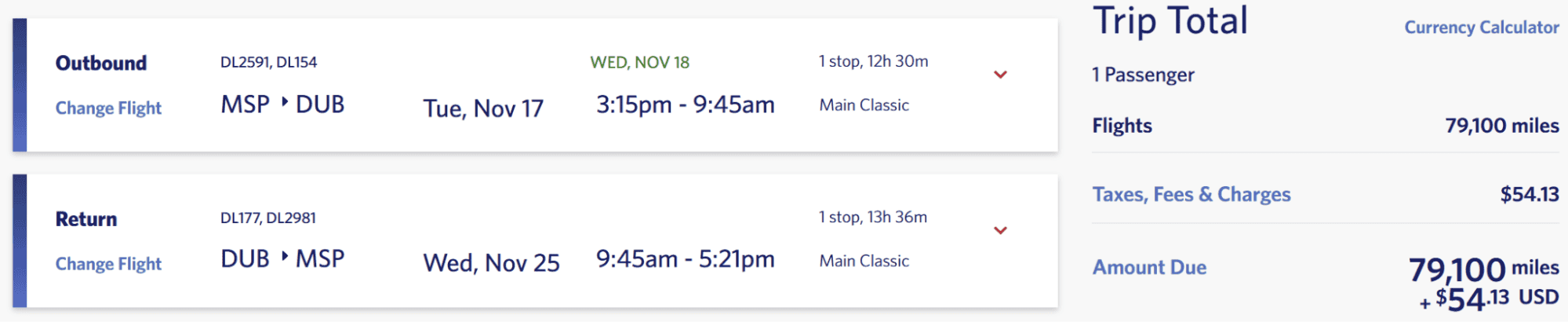
Image courtesy of Delta Air Lines
Those exact same flights booked as two one-way awards would cost you 115,100 SkyMiles.
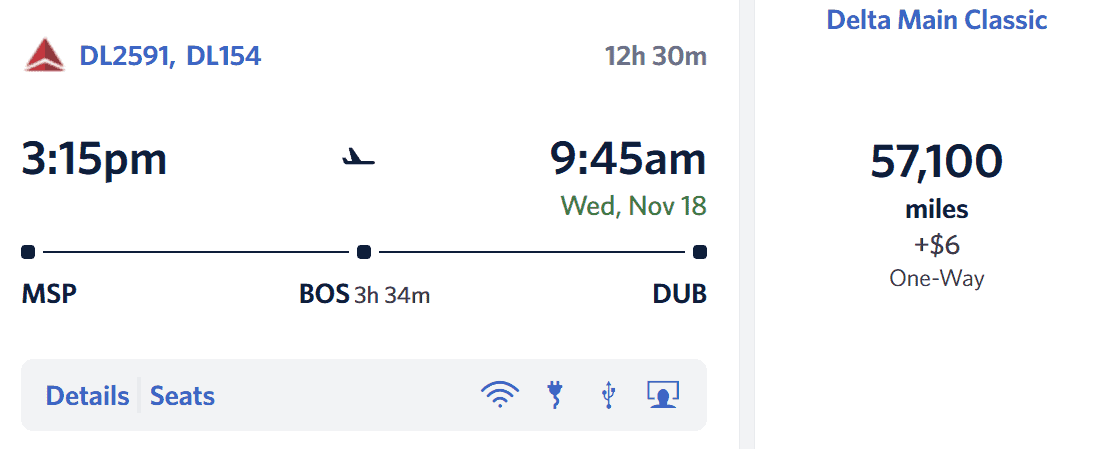
Image courtesy of Delta Air Lines
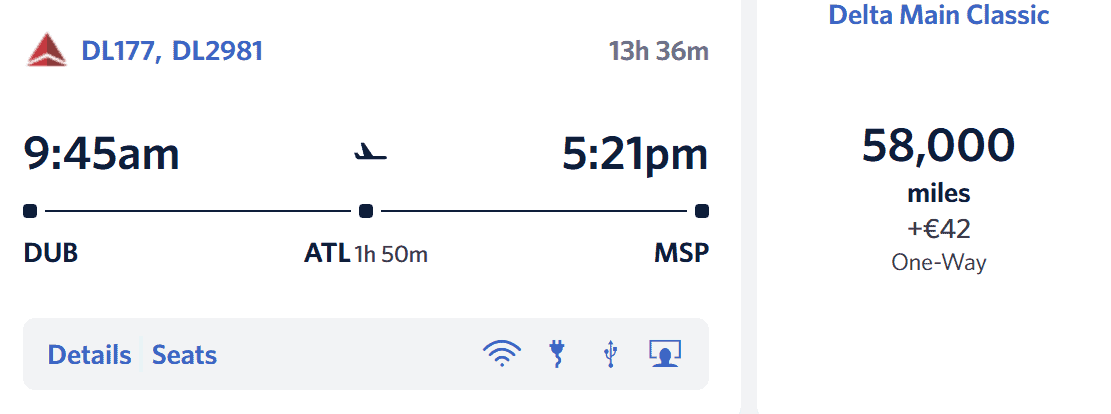
Image courtesy of Delta Air Lines
That’s a significant surcharge for one-way bookings.
How to Find and Compare One-Way Award Flights
Navigating multiple bookings requires a structured approach to ensure you’re getting the most value out of your points. By mastering the search process and evaluating the underlying costs of each ticket, you can accurately weigh your options before transferring any transferable credit card points to a single airline partner.
Searching for One-Way Award Availability
Whether you’re booking one-way or round-trip award tickets, always start your search by looking for one-way tickets. That’s because it’s far easier to find saver rates and award space when you’re searching for just one leg of the journey.
Many airline websites allow you to select “flexible dates” when searching, which usually gives you a monthly award calendar overview. This is a great way to see which days are cheapest to fly and where award space exists.
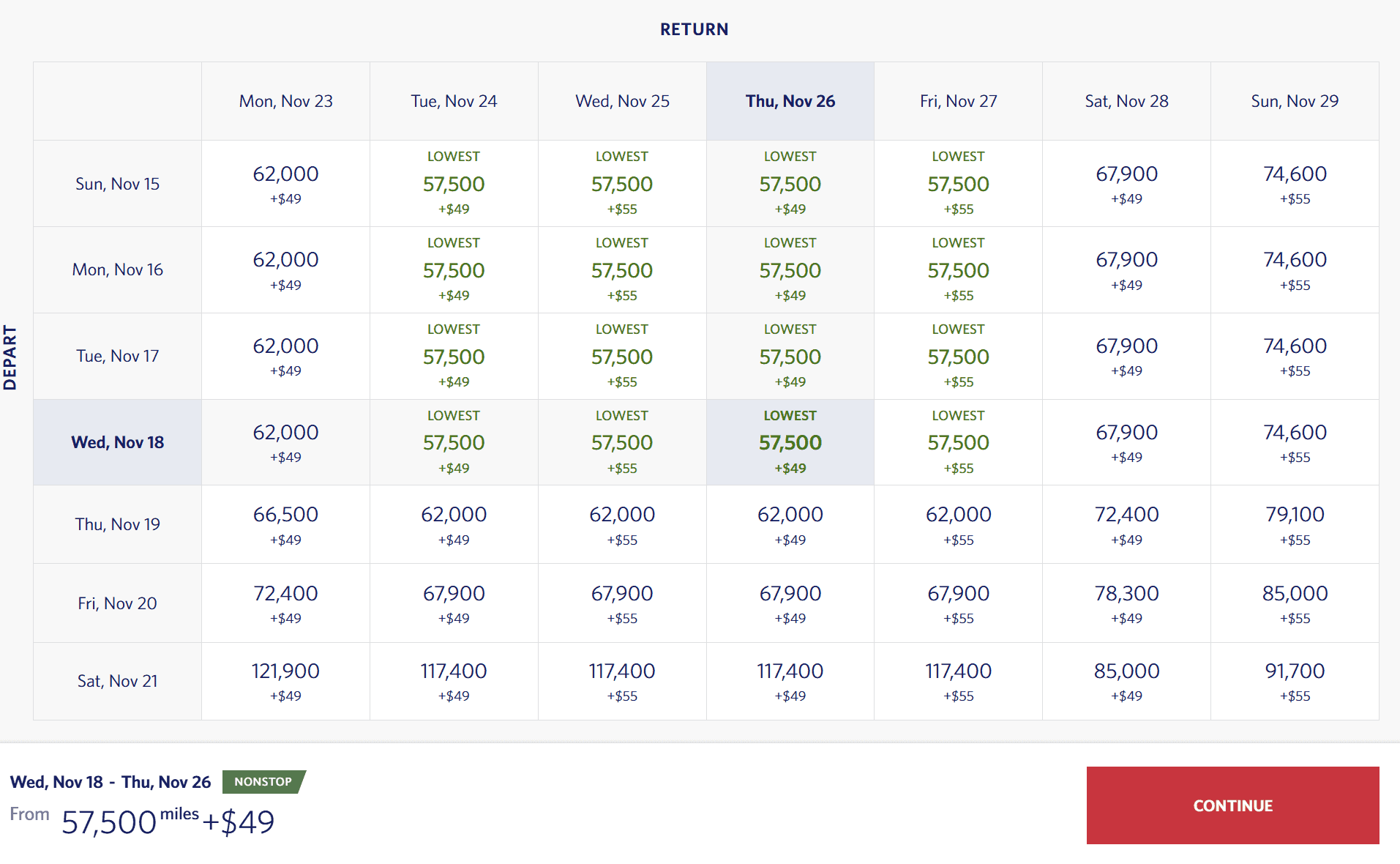
Delta’s calendar search function
If you’re planning a simple round-trip itinerary, you can do this for both the outbound and return leg. For a more complex open-jaw itinerary, you can play around with the dates, airports and even loyalty programs to find the best rates. Once you’ve found availability, you can input the same dates and route as a round-trip ticket to compare round-trip vs. one-way rates.
Comparing Cash Airfare Against Award Redemptions
Because one-way cash tickets on traditional legacy carriers are often artificially inflated, it’s important to calculate the cents-per-point value of a one-way award to ensure it makes financial sense. To find this baseline metric, subtract any taxes and fees from the cash price of the one-way flight, then divide that number by the total miles required for the award booking.
If a one-way cash ticket from Europe back to the U.S. costs an astronomical $1,500, but you can book it for 30,000 miles plus $150 in taxes, your redemption yields a lucrative 4.5 cents per point.
Conversely, if a domestic one-way award ticket demands 12,500 miles plus taxes but the equivalent cash price is $79, your value drops below 0.6 cents per point. In that scenario, saving your miles and paying the cash rate for the individual leg preserves your rewards balance for a much higher-value redemption down the road.
If the math works in your favor, it can be worthwhile to book one leg using points and the other using cash.
Making One-Way Flights Your Default Booking Strategy
To maximize the value of your points, make one-way award searches your default strategy when planning future trips. Follow this simple three-step checklist to help you evaluate your options:
- Audit individual segments: Search for award availability for your outbound and return journeys independently of one another, mapping out which airlines offer the best times and lowest mileage rates for each specific leg. Use an award flight search tool to make the process easier.
- Calculate the standalone value: Run the cents-per-point math on both flights separately to determine if each leg of the trip is an excellent candidate for using miles or if you might be better off paying cash.
- Check for program exceptions: Before booking, run a quick search on a standard round-trip for the same dates to verify that a round-trip discount doesn’t outweigh the benefits of one-way tickets.
By breaking the habit of relying on a single airline for your entire trip, you’ll uncover redemption opportunities that most travelers overlook.

New to the world of points and miles? The Capital One Venture Rewards Credit Card is the best card to start with.
Current offer: Limited Time Offer: Enjoy a $300 stays credit, plus earn 75K bonus miles once you spend $4,000 on purchases within 3 months from account opening.
Earn 5X miles on hotels, vacation rentals and rental cars booked through Capital One Travel; 2X miles on all purchases.
Editors Note: Opinions expressed here are author’s alone, not those of any bank, credit card issuer, hotel, airline, or other entity. This content has not been reviewed, approved or otherwise endorsed by any of the entities included within the post.
10xTravel is part of an affiliate sales network and receives compensation for sending traffic to partner sites, such as CreditCards.com. This site may earn compensation when a customer clicks on a link, when an application is approved, or when an account is opened. This compensation may impact how and where links appear on this site. This site does not include all financial companies or all available financial offers. Terms apply to American Express benefits and offers. Enrollment may be required for select American Express benefits and offers. Visit americanexpress.com to learn more. All values of Membership Rewards are assigned based on the assumption, experience and opinions of the 10xTravel team and represent an estimate and not an actual value of points. Estimated value is not a fixed value and may not be the typical value enjoyed by card members.
Editors Note: Opinions expressed here are author’s alone, not those of any bank, credit card issuer, hotel, airline, or other entity. This content has not been reviewed, approved or otherwise endorsed by any of the entities included within the post.
bonus cash back
after you spend $6,000 on purchases in the first 3 months from account opening.
earn 75K bonus miles
once you spend $4,000 on purchases within 3 months from account opening.
bonus points
after you spend $5,000 on purchases in the first 3 months from account opening.
Membership Rewards® Points
after you spend $8,000 in eligible purchases on your new Card in your first 6 months of Card Membership. Welcome offers vary and you may not be eligible for an offer. Apply to know if you’re approved and find out your exact welcome offer amount – all with no credit score impact. If you’re approved and choose to accept the Card, your score may be impacted.